

The Complete Travel Tipping Guide for 2026: How Much to Tip in 30+ Countries
Travel Tipping Guide 2026

Travel Tipping Guide 2026
You just finished a fantastic dinner in Rome. The pasta was perfect. The waiter was charming. Now the bill arrives and your brain short-circuits.
Do you leave 20% like back home? Round up to the nearest euro? Or is tipping actually offensive here?
If you've ever frozen at a restaurant table abroad, fumbling with unfamiliar currency while trying not to commit a cultural faux pas, you're not alone. Tipping customs vary wildly from country to country — and getting it wrong can range from mildly embarrassing to genuinely insulting.
This guide breaks down exactly how much to tip in every major travel destination, so you can stop stressing and start enjoying your trip.
✈️ Planning an international trip? Let Autopilot handle your flight and hotel bookings — we monitor for price drops and rebook automatically so you save money without lifting a finger.

Bookmark this. Screenshot it. Save it to your phone. This is the only tipping chart you need for your next international trip.
| Country | Restaurant | Hotel Staff | Taxi | Tour Guide | Key Rule |
|---|---|---|---|---|---|
| USA | 18–25% | $2–5/bag, $5/night | 15–20% | 15–20% | Always tip — 20% is the new baseline |
| Canada | 15–20% | C$2–5/bag, C$5/night | 15% | 15–20% | Tip on pre-tax amount |
| Mexico | 10–15% | 20–50 MXN/bag | Round up | 10–15% | Always tip in pesos, not USD |
| UK | 10–12.5% (if not added) | £1–2/bag | Round up | 10% | Check if service charge is included |
| France | Round up / 5–10% | €1–2/bag | Round up | €5–10 | Service compris — tip is included by law |
| Italy | Round up / 5–10% | €1–2/bag | Round up | €5–10 | Coperto (cover charge) replaces tips |
| Spain | Round up / 5–10% | €1–2/bag | Round up | €5–10 | Leaving coins on the table is fine |
| Germany | 5–10% or round up | €1–2/bag | Round up | €5–10 | Tell the server total amount, don't leave on table |
| Japan | Do NOT tip | Do NOT tip | Do NOT tip | Envelope only | Tipping can be considered rude |
| Thailand | Round up / 10% | 20–50 THB/bag | Round up | 200–500 THB/day | Never leave coins — it’s considered insulting |
| Vietnam | 5–10% (optional) | 20,000–50,000 VND | Round up | 100,000–200,000 VND | Not expected but appreciated |
| Indonesia / Bali | 5–10% (if no service charge) | IDR 10,000–20,000 | Round up | IDR 50,000–100,000 | Check bill for service charge first |
| UAE / Dubai | 10–15% (if not added) | AED 5–10/bag | Round up / AED 5–10 | AED 20–50/person | Many restaurants auto-add 10% service |
| Turkey | 5–15% | 100–200 TRY/bag | Round up | 10–15% | Leave cash on table — card tips rarely reach staff |
| Australia | Not expected (10% for great service) | Not expected | Round up | A$5–10 | Living wages mean no obligation |
| New Zealand | Not expected | Not expected | Not expected | NZ$5–10 | Tipping can feel awkward to locals |
| China | Not expected | Not expected | Not expected | Optional | Tipping is uncommon and can cause confusion |
| Singapore | Not expected (10% often added) | Not expected | Not expected | Optional | Service charge + GST already on bill |
| South Korea | Do NOT tip | Not expected | Not expected | Optional | Similar to Japan — tips can offend |
Let's start with the big one. The US has the most aggressive tipping culture on the planet, and in 2026 it's only gotten more intense.
At sit-down restaurants, 20% is now the baseline for acceptable service. Not great service — just acceptable. For genuinely excellent service, many Americans tip 22-25%. The old 15% standard? That now reads as a signal that something went wrong.
Beyond restaurants, tipping touches almost every service interaction. Baristas, rideshare drivers, hotel housekeeping, valet attendants, food delivery — the expectation is everywhere. Budget an extra 20% on top of service costs when traveling in the US.
Canada mirrors the US tipping culture closely. Restaurants expect 15-20% and the payment terminal defaults typically start at 18%.
The one critical difference: always calculate your tip on the pre-tax total. Canadian sales tax varies by province (5-15%), and tipping on the tax-included amount is a common tourist trap that can inflate your tip significantly.
In Mexico, 10-15% at restaurants is standard, with 15-20% reserved for outstanding service. At all-inclusive resorts, tip housekeeping 25-50 pesos per day and bellhops 25-50 pesos per bag.
The number one rule: tip in Mexican pesos, not US dollars. Yes, tourist areas accept dollars, but local workers lose money on the exchange rate. It takes 30 seconds at an ATM to withdraw pesos. Do it.
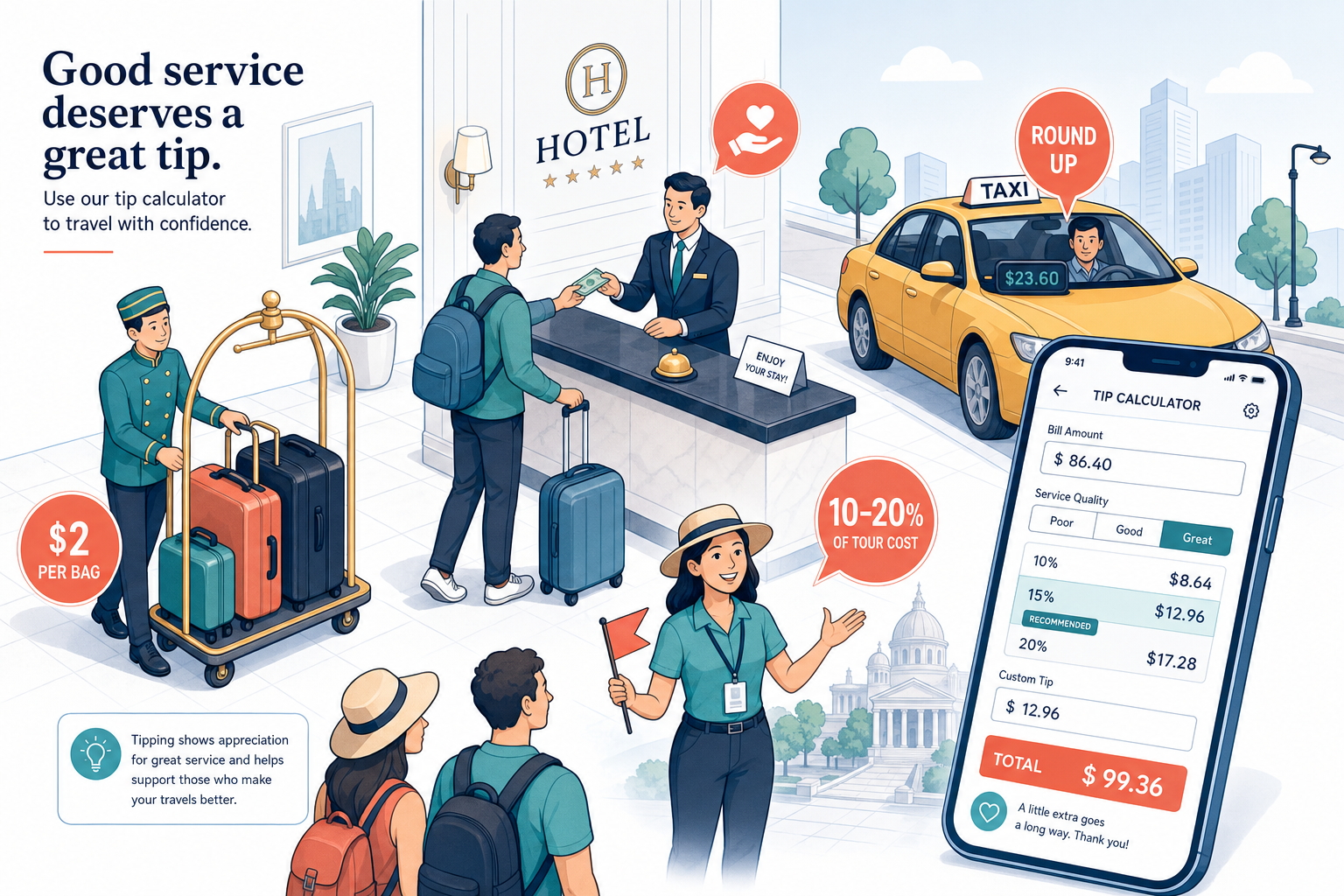
Americans tend to wildly over-tip in Europe. Here's the reality: European servers earn a living wage, and tipping is a genuine bonus rather than a survival mechanism.
Service is included by law in France (service compris). That means every restaurant bill already has the tip baked in. Leaving an extra 5-10% or rounding up is a kind gesture for great service, but nobody is expecting it.
Look for the coperto on your bill — that's a cover charge of 1-3 euros per person that essentially functions as the gratuity. Beyond that, rounding up or leaving a euro or two on the table is plenty. Italians almost never tip 15-20%.
Tipping in Spain is wonderfully low-pressure. Leaving small change on the table after a meal is common. In a sit-down restaurant, rounding up or leaving 5-10% for exceptional service is generous. At a tapas bar, nobody expects a thing.
Germans have a unique tipping custom: you tell the server the total amount you want to pay, including the tip. If your bill is 37 euros, you say "forty" and hand over a 50-euro note. Leaving coins on the table after the server has left is considered slightly rude.
Many UK restaurants add a "discretionary service charge" of 10-12.5% to your bill. If it's already there, you don't need to add more. If it's not, 10% is standard. In pubs, tipping is uncommon unless you're ordering food at a table.
✈️ Flying to Europe this summer? Autopilot finds the best flight deals and tracks prices after you book — if the fare drops, we rebook you at the lower price automatically.
This is the most important entry in the entire guide. Do not tip in Japan. Not at restaurants, not at hotels, not in taxis. Leaving money on the table will likely cause confusion, and staff may chase you down to return it.
In Japanese culture, exceptional service is the standard — not something that requires extra payment. Tipping can be interpreted as implying the worker isn't being paid fairly, which is considered disrespectful.
The only exceptions: at a traditional ryokan (Japanese inn), you can give kokorozuke — a small amount in an envelope — to the attendant. And private tour guides may accept a discreet cash tip. Both situations require the money to be placed in an envelope, never handed over as bare cash.
Tipping in Thailand is appreciated but not mandatory. At restaurants, rounding up the bill or leaving 10% is a nice gesture. For hotel porters, 20-50 baht per bag is standard.
One critical cultural note: never leave coins as a tip in Thailand. Coins are associated with what you give to beggars, and leaving them can be taken as an insult. Use paper bills only.
Vietnam is one of the few Southeast Asian countries where tipping is genuinely optional with no hidden service charges. A 5-10% tip at a restaurant is appreciated but far from expected. For tour guides and drivers, 100,000-200,000 VND per day is generous.
In Bali's tourist zones, tipping culture has grown significantly. Check your bill first — many restaurants add a 10% service charge automatically. If no charge is included, 5-10% is appreciated. Hotel porters typically receive IDR 10,000-20,000 per bag.
Dubai is a tipping-friendly city, but check your bill first. Many restaurants automatically add a 10% service charge. If it's already included, you've already tipped.
When a service charge isn't included, 10-15% is standard at restaurants. Hotel porters expect AED 5-10 per bag, and housekeeping gets AED 10-20 per day. For desert safaris and tours, AED 20-50 per person is customary.
Tipping in Turkey is a genuine gesture of appreciation, not a wage supplement — service staff earn full salaries. At restaurants, 5-15% is standard, with higher percentages reserved for upscale dining.
The most important Turkey tip (no pun intended): always leave cash on the table, even if you paid the bill by card. Tips added to card payments notoriously don't reach the server. And use Turkish Lira — workers getting paid in foreign currency get shortchanged on the exchange.
Beyond Mexico, most of Latin America follows a similar pattern: 10% is standard at restaurants, with some countries adding a service charge (called propina or servicio) automatically.
In Colombia and Peru, a 10% voluntary service charge (propina voluntaria) is typically added to restaurant bills. You can decline it, but accepting it is the norm. In Brazil, a 10% taxa de serviço is almost always included, making additional tipping unnecessary.
Australia's minimum wage sits at A$23.23 per hour — one of the highest in the world. This means service workers aren't depending on tips to survive, and nobody will judge you for not leaving one.
That said, tipping culture has crept in slightly since the pandemic, particularly in Melbourne and Sydney. A 10% tip at a genuinely excellent restaurant is warmly received but never expected.
Even less tipping culture than Australia. Kiwis view fair wages as the employer's responsibility, and many locals consider tipping to be at odds with that principle. If you want to show appreciation, a sincere "thank you" carries more weight than cash.
Sometimes the question isn't "which country" but "which service." Here's a global breakdown by service type.
Always check the bill for an included service charge before tipping. In the US and Canada, tip on the pre-tax amount. In Europe, service is often included. In Asia, check for a "service charge" or "SC" line item.
Bellhops/porters: $1-5 per bag depending on the country. Housekeeping: $2-5 per night in the US/Canada, less elsewhere. Leave the tip daily — housekeeping staff rotate, and a single tip at checkout only reaches one person.
In the US and Canada, 15-20% is standard. In most other countries, rounding up to the nearest convenient amount is sufficient. Many rideshare apps now include in-app tipping, which makes things easier internationally.
This is one area where tipping is appreciated almost everywhere, even in countries with no general tipping culture. For group tours, $5-10 per person per day is standard globally. For private guides, 10-15% of the tour cost is generous.
In the US, 15-20% is expected. In Southeast Asia, tipping spa therapists is appreciated but not required — 10% or a flat amount equivalent to $3-5 is generous. In Europe and Australia, tipping at spas is uncommon.
Most cruise lines automatically add daily gratuities of $14-20 per person per day to your onboard account. This covers your cabin steward, dining staff, and behind-the-scenes crew. Additional cash tips for exceptional bartenders or room service are at your discretion.
This might be the most freeing section of this entire guide. In these countries, you can put your wallet away with zero guilt.
In all of these countries, the best way to show appreciation is simply being a polite, respectful guest.
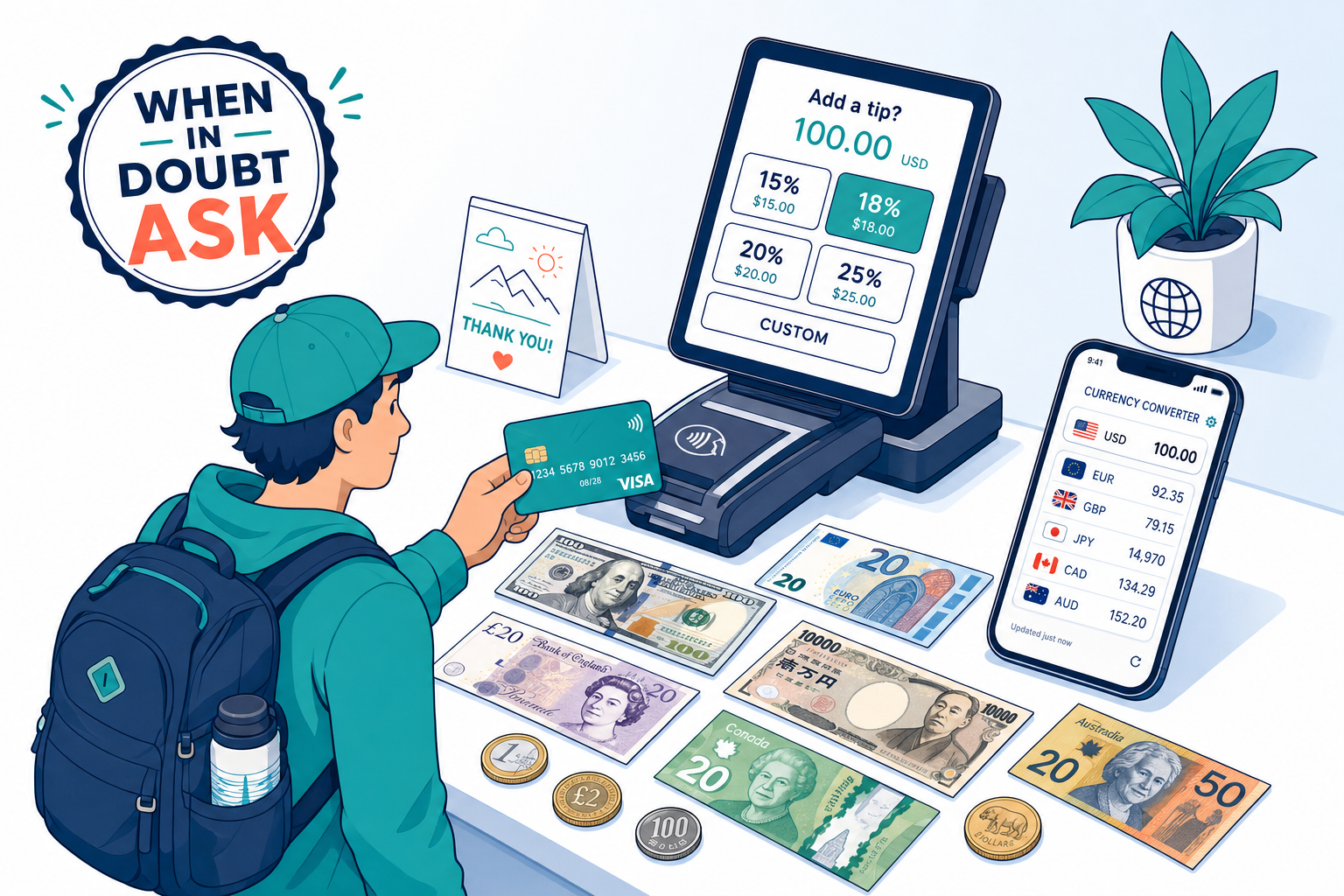
The global shift to cashless payment has complicated tipping in ways nobody anticipated. Here's how to handle it.
When you tip on a credit card internationally, your card issuer converts the tip amount along with the bill. If your card charges foreign transaction fees (typically 1-3%), those fees apply to the tip amount too. Use a no-foreign-transaction-fee card whenever possible.
Apple Pay and Google Pay tipping depends entirely on the merchant's point-of-sale system, not on Apple or Google. In the US, most terminals now prompt for a tip amount during contactless payment. Internationally, this feature is less common, and many countries don't have tipping prompts at all.
In Turkey, Mexico, Thailand, Vietnam, and much of Latin America, cash tips are strongly preferred. Card tips at restaurants often don't reach the actual server. Withdraw local currency at airport ATMs (skip the currency exchange counters) and keep small bills handy for tips throughout your trip.
Some countries have adopted QR-code tipping at restaurants and hotels. The UK's TiPJAR system and similar platforms let you tip directly to staff via a QR scan on the table, ensuring 100% of the tip reaches the worker. Look for these options, especially in London and other major European cities.
Tipping culture isn't static. Here are the biggest shifts happening right now.
The term "tipflation" — the creep of higher tipping expectations — defines the 2026 US dining landscape. Digital payment screens now default to 20%, 25%, and even 30% suggested tips at counter-service spots where no tipping was expected just a few years ago.
The backlash is real, though. Pickup order tipping rates have dropped from 78% in 2022 to 62% in 2026. Consumers are pushing back on tipping for counter service and takeout, even as full-service restaurant tips remain steady at around 19.4%.
The pandemic supercharged tipping culture in the US and Canada, as consumers tipped generously to support service workers during lockdowns. Those elevated expectations stuck. Meanwhile, digital tipping screens spread globally, appearing in countries like the UK, Australia, and even parts of continental Europe where tipping was historically minimal.
Three in four US consumers say they've noticed restaurants raising minimum suggested tips on digital screens. This "guilt tipping" phenomenon — where the screen faces you while the server watches — is one of the most complained-about trends in the hospitality industry. It's now spreading to Canada, the UK, and Australia.
Interestingly, 56% of consumers say they'd be willing to pay higher menu prices if it meant eliminating tipping entirely. Some US restaurants have experimented with service-included pricing, though widespread adoption remains years away.
No. Tipping in Japan is not customary and can be considered rude. Excellent service is the cultural standard, not something requiring extra payment. The only exceptions are discreet cash gifts in envelopes at traditional ryokans or for private tour guides.
Much less than in the US. Most European countries include service in the bill price. Rounding up or leaving 5-10% is generous in France, Italy, Spain, and Germany. In the UK, check for a discretionary service charge of 10-12.5% before adding more.
In 2026, 15% at a sit-down restaurant signals dissatisfaction. The new baseline for adequate service is 18-20%, with 22-25% for great service. At counter-service spots, 10-15% or nothing is perfectly acceptable.
Almost always no. Tip in local currency whenever possible. Workers who receive US dollars often lose money on exchange rates or face inconvenience converting them. Withdraw local cash from ATMs before your trip or upon arrival.
In the US, Canada, and the UK, card tipping works fine. In many other countries (Turkey, Mexico, much of Asia and Latin America), cash tips are preferred because card tips may not reach the server. Try to have some local cash on hand, even in a mostly cashless world.
Generally no. A service charge is the tip. This is common in the UK, Singapore, Dubai, Bali, France, and many all-inclusive resorts. Double-check the bill before adding extra, but leaving a small amount beyond the service charge for truly exceptional service is always a nice gesture.
In the US, $3-5 per night. In Mexico, 25-50 pesos per day. In Europe, 1-2 euros is appreciated. In Asia and Oceania, it's generally not expected. Always leave the tip daily rather than at checkout, since housekeeping staff rotate shifts.
Don't worry too much. In most "no-tip" countries like Japan or South Korea, the staff will likely try to return the money politely. It's not a major offense — just an awkward moment. Simply accept the money back graciously, say thank you, and move on.
✈️ Ready to book your next trip? Try Autopilot for free — we handle flights, hotels, and price tracking so you can focus on the fun stuff (like figuring out what 20,000 Vietnamese Dong looks like).
Disclaimer: Tipping customs can vary by region, establishment, and individual circumstance. The percentages and amounts in this guide are general guidelines based on widely reported norms as of 2026. When in doubt, observe what locals do, ask your hotel concierge, or err on the side of modest generosity. This article is for informational purposes only and does not constitute financial or legal advice.

