

Open Jaw Flights: What They Are, How to Book Them, and When They Save You Money
Fly into one city, out of another — all on one ticket. Here's how open jaw flights work and when they're worth booking.

Fly into one city, out of another — all on one ticket. Here's how open jaw flights work and when they're worth booking.
If you've ever planned a trip to Europe and dreaded the idea of backtracking hundreds of miles just to catch your return flight from the same airport you landed in — there's a better way. It's called an open jaw flight, and it's one of the most underrated booking strategies in travel.
An open jaw flight lets you fly into one city and out of another, all on a single ticket. Think of it as a round-trip ticket with a gap in the middle — a gap you fill however you want. Here's everything you need to know.
An open jaw flight is an airline ticket where your departure city and arrival city don't match on at least one end of the trip. Instead of the classic A-to-B, B-to-A round trip, you're flying A-to-B, then C-to-A — with the "jaw" being the open gap between B and C that you cover on your own.
Airlines treat open jaw tickets similarly to round-trip fares for pricing purposes. That's the key insight. You're not paying for two expensive one-way tickets. You're getting round-trip pricing with far more flexibility.
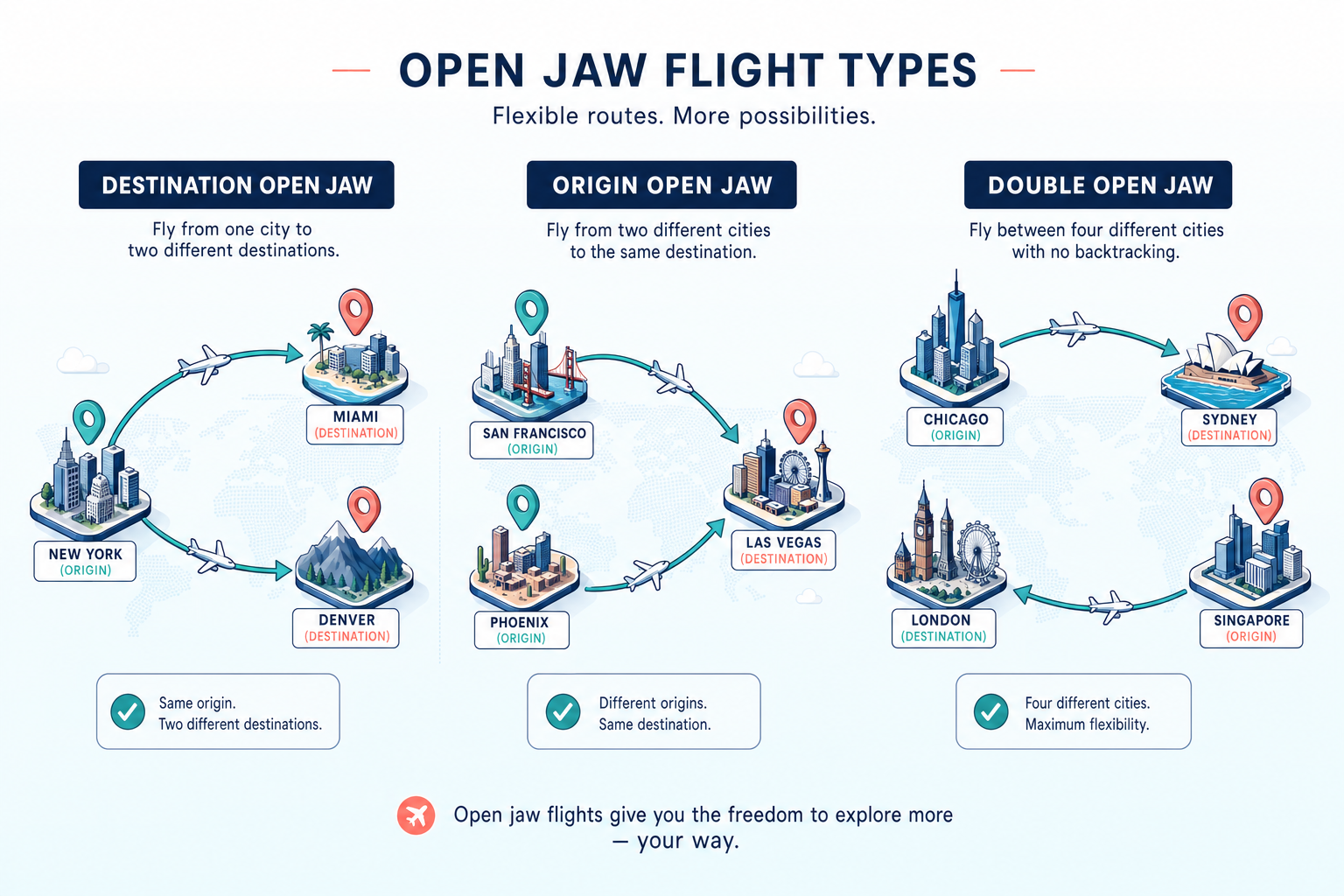
Not all open jaw itineraries look the same. There are three distinct types, and understanding the differences helps you pick the right one for your trip.
This is the most common type. You fly into one destination and return home from a different one. Your origin city stays the same on both ends.
Example: New York → London, then Paris → New York. You cover London to Paris on your own — by Eurostar, rental car, or budget flight.
Here, you flip it. You fly to and from the same destination, but your departure and arrival airports at home are different.
Example: Chicago → Rome, then Rome → New York. You might have a friend drop you at O'Hare, then take the train home from JFK. This works well if you live between two major airports or are combining the trip with a visit to family in another city.
The most flexible — and complex — option. Both ends of the trip have different cities. Neither your origin nor your destination matches up.
Example: Washington, D.C. → Munich, then Athens → Boston. You've got a gap on both sides — you travel from Munich to Athens in Europe, and you get yourself from Boston back to D.C. at home.
Double open jaws are harder to price and not every booking tool supports them, but they're powerful for complex itineraries.
These terms get thrown around interchangeably, but they're not the same thing.
A round trip is straightforward: A → B → A. Same airports, both directions.
An open jaw has two flight segments where at least one endpoint doesn't match: A → B, C → A. You handle the B-to-C gap yourself.
A multi-city itinerary includes flights between all your stops — three or more segments booked together. A → B, B → C, C → A. Every leg has a flight.
Open jaws are usually priced like round trips. Multi-city fares can be priced as a bundle of one-ways, which sometimes costs more.
| Feature | Round Trip | Open Jaw | Multi-City |
|---|---|---|---|
| Flight segments | 2 | 2 | 3+ |
| Same airports both ends | Yes | No | Varies |
| Ground transport needed | No | Yes (the "jaw") | No |
| Typical pricing | Round-trip fare | Round-trip fare | Sum of one-ways (varies) |
| Best for | Single destination | Linear trips | 3+ distinct cities |
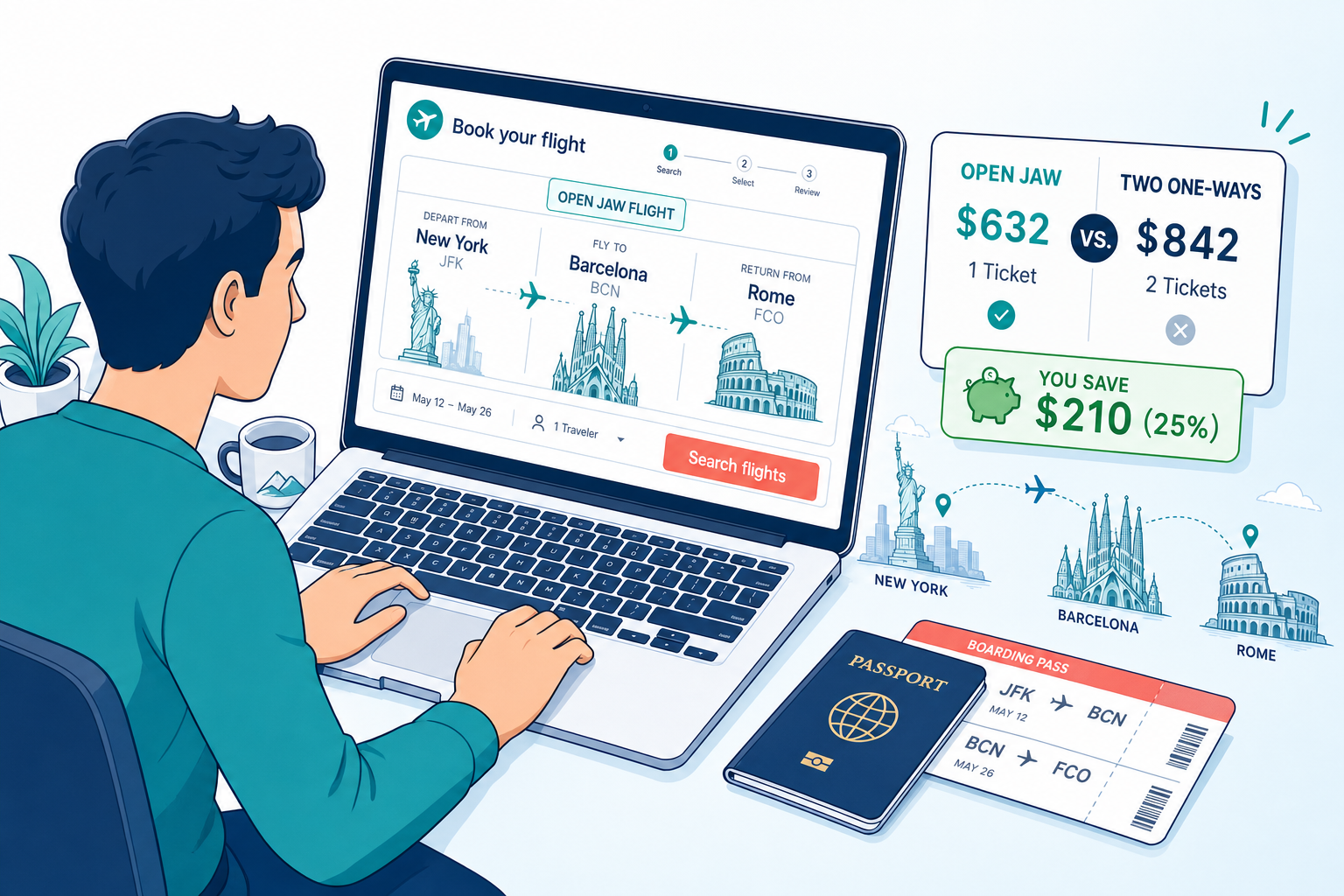
Booking an open jaw flight is easier than most people think. You don't need a travel agent or special tools — the option is built into most flight search engines.
On Google Flights, or directly on an airline's website, look for the "Multi-city" option instead of "Round trip." This is your entry point for open jaw bookings.
For a destination open jaw, enter your outbound flight (e.g., New York → London) as the first leg. Then enter your return flight from the different city (e.g., Paris → New York) as the second leg.
Always compare your open jaw price against: (1) a standard round trip to either city, and (2) two separate one-way tickets. Sometimes the round trip plus a cheap intra-Europe flight wins. Other times the open jaw is clearly cheaper.
Once you've booked your open jaw itinerary, Autopilot monitors both legs for price drops — so if either segment gets cheaper after purchase, you capture the savings automatically. This is especially valuable with open jaw fares since you have two separate segments that can each fluctuate independently.
The biggest savings from open jaw flights aren't always in the airfare itself — they're in the time, money, and hassle you save by not backtracking.
Say you're planning a two-week trip through Italy. You want to start in Rome and end in Milan. A round trip into Rome means after Milan, you're spending half a day and $50+ on a train back to Rome just to catch your flight. An open jaw ticket eliminates that entirely.
On the airfare side, open jaw tickets are typically priced comparably to round trips — not as two one-ways. That's the critical point. In one real-world example, an open jaw ticket cost $1,144 while the same segments booked as two separate one-way tickets ran $2,080. That's over $900 in savings.
Open jaw fares can fluctuate just like any other ticket. Setting up automatic fare monitoring with Autopilot means you're always getting the best price, even after booking.
Open jaw isn't always the right play. If your destinationcities are far apart and theground transportation between them is expensive or time-consuming, you might end up spending more to bridge the gap than you'd save on airfare.
They also don't make sense when a round trip to a single city is dramatically cheaper. Some routes have fierce competition that pushes round-trip fares way down — in those cases, the math might favor a standard round trip plus a separate positioning flight.
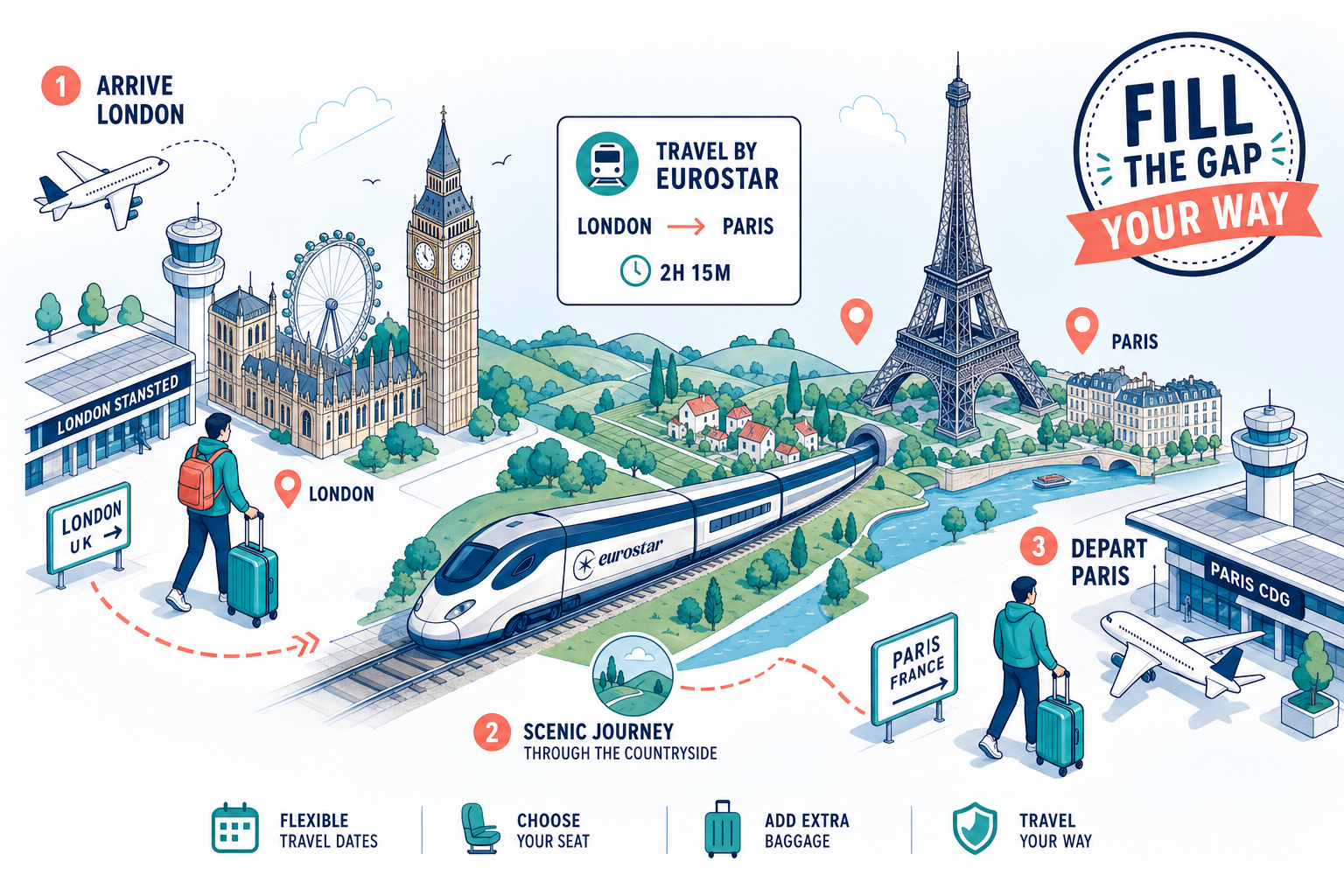
Also consider luggage. You'll haul everything between cities on your own during the open jaw segment. No checked bag conveyors between London and Paris — just you and your suitcase on the Eurostar.
Open jaw bookings work with loyalty programs, and some programs actively encourage them.
Alaska Airlines Mileage Plan allows open jaws on international award tickets and even permits stopovers, making it one of the most generous programs for complex routing.
Air Canada Aeroplan and Air France-KLM Flying Blue also support open jaw award bookings, though the specific rules vary by program and you may need to call to book more complex itineraries.
For cash bookings, you'll earn miles on both segments just like a regular round trip. Make sure your loyalty number is attached at the time of booking.
Since an open jaw itinerary is booked as a single ticket, your baggage allowance is typically consistent across both flight segments. If your outbound includes two free checked bags, your return should too.
The wrinkle comes with the gap segment. Between your two flights, you're responsible for your own luggage. If you're taking a train from London to Paris, you're carrying everything with you. Pack light.
If your open jaw involves different airlines on each segment, double-check each carrier's baggage rules. You don't want surprises at the check-in counter.
European road trips: Fly into London, train through France, fly home from Barcelona. Europe's rail network makes open jaw itineraries a natural fit. Popular combos include London→Paris, Rome→Milan, Budapest→Prague via Vienna, and Lisbon→Porto.
U.S. road trips: Fly into San Francisco, drive the Pacific Coast Highway, fly home from Los Angeles. Or land in Nashville, hit Memphis and New Orleans, fly home from NOLA.
Business travel: When meetings are in different cities, open jaw eliminates the dead-leg return to your first city.
Cruise itineraries: Cruises that start in one port and end in another are tailor-made for open jaw flights. Fly into Barcelona for embarkation, fly home from Rome at the end.
Wherever your trip follows a linear path rather than a loop, open jaw is probably the right call. And once you've booked, let Autopilot keep an eye on pricing so you're covered if fares shift after purchase.
To make this concrete, here are some popular open jaw routes and what you can typically expect:
| Route | Type | Gap Transport | Typical Savings vs. Two One-Ways |
|---|---|---|---|
| NYC → London, Paris → NYC | Destination open jaw | Eurostar (~2.5 hrs, ~$50-150) | $300-900+ |
| Chicago → Rome, Milan → Chicago | Destination open jaw | High-speed train (~3 hrs, ~$30-60) | $200-600+ |
| LAX → Tokyo, Bangkok → LAX | Destination open jaw | Budget airline (~6 hrs, ~$100-200) | $400-1,000+ |
| D.C. → Munich, Athens → Boston | Double open jaw | Intra-Europe flight (~3 hrs, ~$50-150) | $300-800+ |
| SFO → Lisbon, Porto → SFO | Destination open jaw | Train (~3 hrs, ~$20-40) | $200-500+ |
These ranges depend on season, airline, and booking lead time. The pattern holds: open jaw pricing consistently beats two separate one-way tickets.
Usually not. Airlines typically price open jaw tickets similarly to round-trip fares. They're almost always cheaper than booking two separate one-way tickets. The real value comes from eliminating backtracking costs and saving time.
Yes. Select "Multi-city" instead of "Round trip" in the search options. Enter your outbound flight as the first leg and your return from a different city as the second leg. Google Flights will show you pricing for the combined itinerary.
Absolutely. Since an open jaw ticket is booked as a single itinerary, you'll earn miles on both flight segments just like a regular round trip. Make sure your loyalty program number is attached to the booking at the time of purchase.
Your checked baggage allowance is determined by your ticket and applies to both flight segments. However, during the gap portion of your trip — the part between your two flights where you travel on your own — you're responsible for transporting your luggage yourself. No airline handles that leg.
Yes, many loyalty programs support open jaw award bookings. Alaska Airlines Mileage Plan, Air Canada Aeroplan, and Air France-KLM Flying Blue all allow them, though rules vary by program. Some may require you to call to book complex open jaw itineraries rather than using the website.
An open jaw flight has two flight segments with a gap that you cover by ground transportation. A multi-city flight has three or more flight segments that cover every leg of your journey. Both are booked using the "multi-city" search option, but open jaws leave one connection for you to handle independently.
No. An open jaw flight is booked as a single itinerary under one confirmation number. This gives you round-trip pricing (usually cheaper) and unified trip protection — if the airline cancels your outbound, your return is covered too. Two one-way tickets are completely independent bookings with no connection.
Skip the open jaw when the ground transport between your two destination cities is expensive, impractical,or eats too much travel time. Also avoid it if a standard round trip to one city is significantly cheaper and your destinations are close enough to visit from a single base. Always compare total trip cost — airfare plus ground transport — before deciding.
Disclaimer: Pricing, availability, and booking procedures vary by airline and route. Information is accurate as of April 2026 but may change. Always verify with your airline or booking platform.

