

Main Cabin vs Basic Economy: What You Actually Give Up (2026 Guide)
Basic economy looks cheaper — until you add up what you lose. Here's the full breakdown across every major U.S. airline.

Basic economy looks cheaper — until you add up what you lose. Here's the full breakdown across every major U.S. airline.
Basic economy fares look like a steal — sometimes $50 to $100 cheaper than main cabin on the exact same flight. But that lower price comes with a catch. Actually, several catches.
The gap between basic economy and main cabin has never been wider. In 2026, all three legacy U.S. carriers have stripped mileage earning from basic economy fares, elite perks are disappearing, and the restrictions keep tightening. What used to be a minor trade-off for a cheaper seat has become a fundamentally different travel experience.
Here's exactly what you give up — and when it's still worth it.
Basic economy is the lowest fare class offered by major U.S. airlines. You're on the same plane, in the same seat type, with the same legroom as a main cabin passenger. The difference is everything around the seat.
No free seat selection. No changes. No upgrades. Last to board. And depending on the airline, potentially no carry-on bag and no miles earned.
Airlines introduced basic economy starting around 2017 to compete with ultra-low-cost carriers. The pitch was simple: strip out the extras, drop the price. But over the years, the "extras" they've stripped have grown to include things most travelers consider essential.
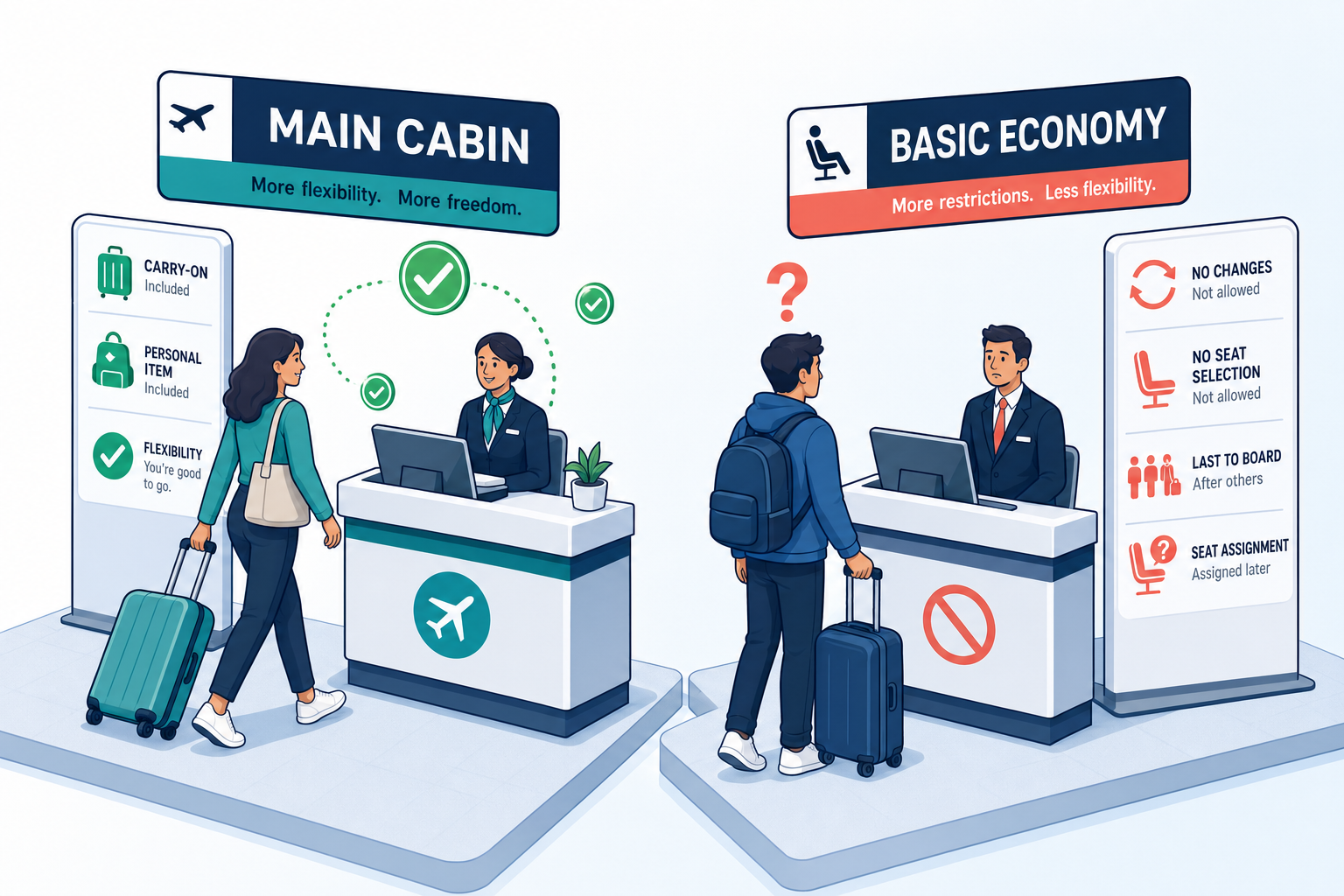
The specifics vary by airline, but here's the universal truth: main cabin gives you flexibility, basic economy gives you a price. That's the entire trade-off.
With main cabin, you pick your seat when you book. With basic economy, you're typically assigned a seat at check-in — and yes, that often means a middle seat in the back.
American and United let basic economy passengers pay extra to select a seat. Delta doesn't even offer that option — you get what you get.
Main cabin tickets can be changed with no fee on all three legacy carriers (you just pay any fare difference). Basic economy tickets? Non-changeable and non-refundable after the 24-hour cancellation window required by the DOT.
This is the restriction that bites hardest. A schedule change, a sick kid, a meeting that moves — with basic economy, you're stuck. With main cabin, you rebook and move on.
Here's where it gets tricky, because airlines handle this differently. American and Delta allow a full-size carry-on in basic economy. United does not — you're limited to a personal item that fits under the seat on domestic flights.
If you show up to a United gate with a roller bag on a basic economy ticket, you'll pay the checked bag fee plus a $25 gate handling charge. That "savings" evaporates fast.
This is the big 2026 change. American Airlines stopped awarding AAdvantage miles and Loyalty Points on basic economy tickets purchased after December 17, 2025. Delta did the same with SkyMiles. United followed on April 2, 2026, eliminating mile earning for most basic economy passengers (cardholders and elites still earn at reduced rates).
If you fly frequently — even just a few trips a year — this matters. Those miles add up, and basic economy now earns you nothing toward status or free flights on two of the three major airlines.
Basic economy passengers board last on every airline. That means overhead bin space is often gone by the time you get on the plane. On United, where you don't get a carry-on anyway, it's less of an issue. On American and Delta, it can mean gate-checking your bag even though the fare technically allows it.
Main cabin passengers are eligible for complimentary upgrades (if they have elite status) and can purchase upgrades. Basic economy passengers are not eligible for any upgrades on any carrier. Period.
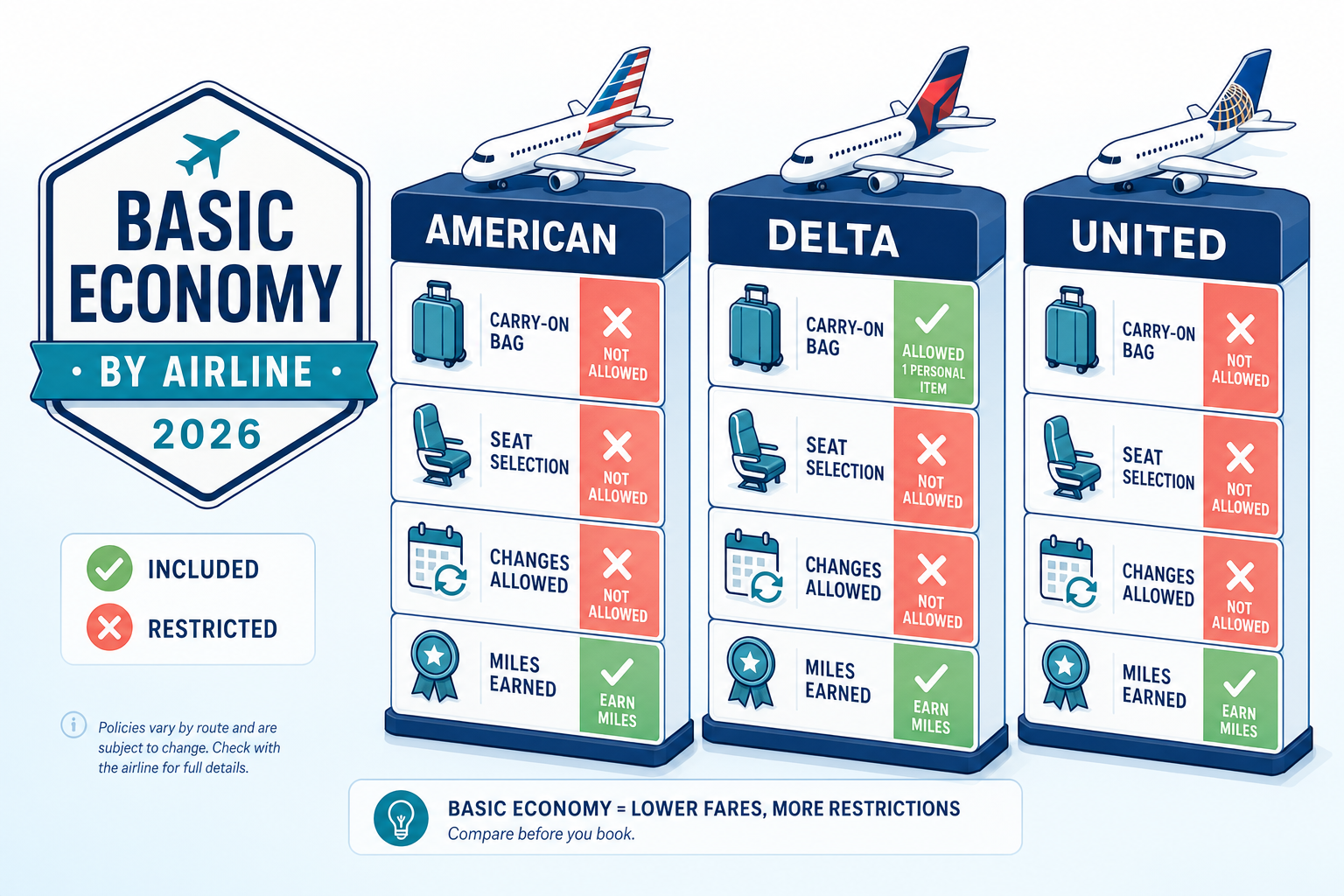
The details matter. Here's how basic economy stacks up across every major U.S. carrier.
| Feature | American (Basic Economy) | Delta (Main Basic) | United (Basic Economy) | JetBlue (Blue Basic) |
|---|---|---|---|---|
| Carry-On Bag | Yes (free) | Yes (free) | No (personal item only) | No (personal item only) |
| Seat Selection | For a fee | No | For a fee | Free within 24 hrs of departure |
| Changes Allowed | No | No | No | Yes (for a fee) |
| Cancellation/Refund | No (24-hr window only) | eCredit minus $99–$199 fee | No (24-hr window only) | No (24-hr window only) |
| Miles Earned | None | None | None (elites/cardholders reduced) | 1 pt/dollar (vs. 3 for Blue) |
| Upgrade Eligible | No | No | No | No |
| Boarding Group | Last | Last | Last | Last |
| Typical Savings | $30–$90 | $30–$80 | $40–$100 | $20–$60 |
Notable: Southwest Airlines doesn't offer basic economy at all. Every Southwest fare includes two free checked bags, no change fees, and no seat assignment restrictions. It's a fundamentally different model.
American's basic economy has gotten significantly worse in 2026. Starting May 18, even elite AAdvantage members lose complimentary seat selection and upgrade eligibility on basic economy tickets. The first checked bag fee jumped to $55 (from the previous rate). And you earn zero miles.
The one upside: you still get a carry-on bag. That's more than United offers.
Delta rebranded its fare tiers in late 2025. What was "Basic Economy" is now "Main Basic," sitting below "Main Classic" and "Main Extra." The restrictions are largely the same — no seat selection, no changes, no miles, last boarding.
Delta's cancellation policy is slightly more forgiving than the others. You can cancel for an eCredit, minus a $99 to $199 fee depending on the route. Not great, but better than getting nothing.
United has the most restrictive basic economy product of the big three. No carry-on bag on domestic flights. No miles for most passengers as of April 2026. No changes, no upgrades.
The carry-on restriction is the killer. If you need anything more than a backpack, you're paying for a checked bag — which can easily eat your entire fare savings.
Credit card holders and Premier elites do get some relief: a free carry-on, earlier boarding, and reduced mile earning. But if you have that status, you're probablynot buying basic economy anyway.
JetBlue's Blue Basic restricts you to a personal item only (no carry-on, no checked bag). Seat selection is free within 24 hours of departure, which is better than Delta's "no selection at all" approach. You earn TrueBlue points, but at a reduced rate — 1 point per dollar versus 3 for the standard Blue fare.
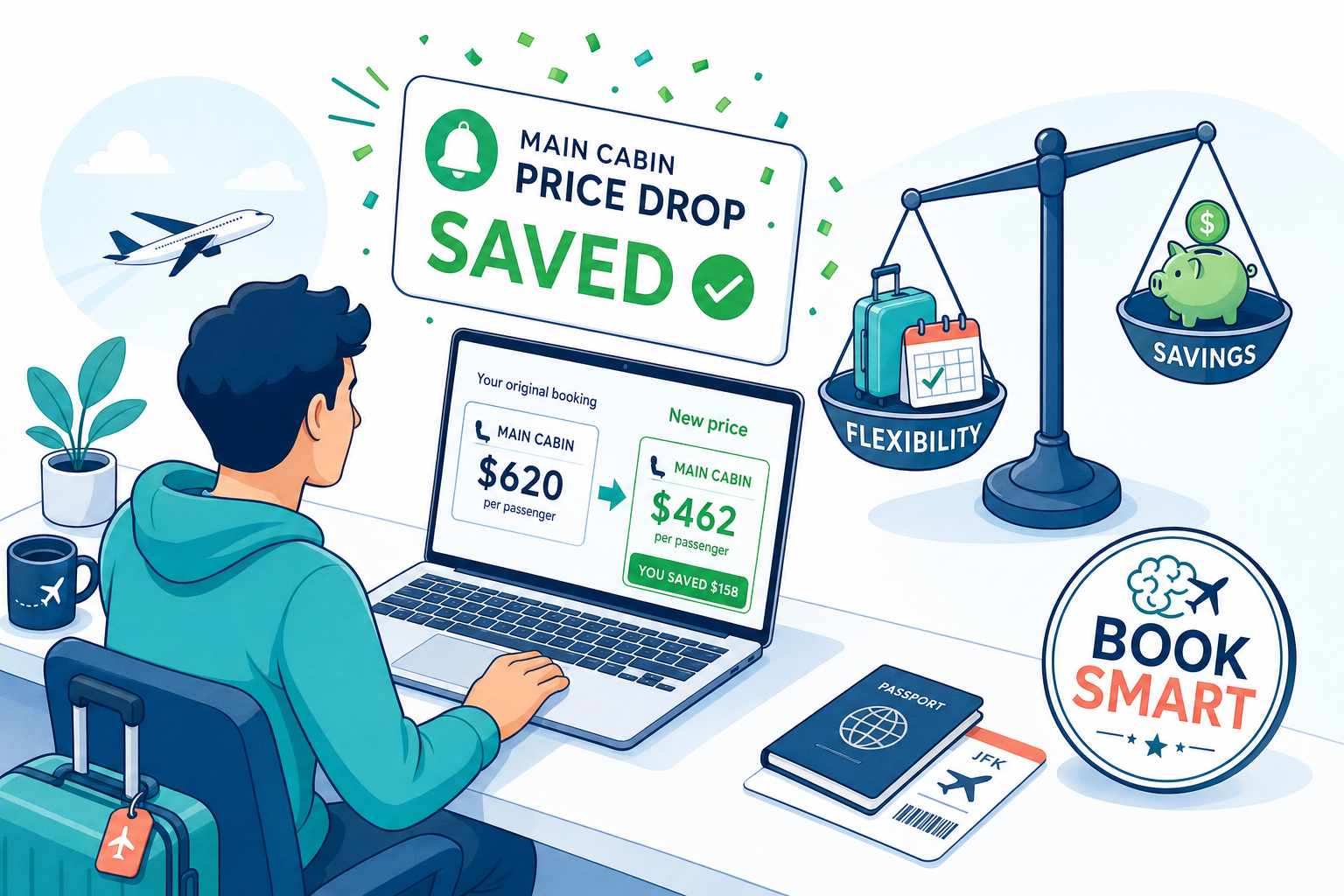
Basic economy's sticker price is lower. But the actual cost? That depends on how you fly.
Here's how the "savings" can disappear:
A traveler who buys basic economy to save $60, then pays $25 for seat selection and $35 for a checked bag, has spent the main cabin price for a ticket with main cabin restrictions still attached. That's a bad deal.
Basic economy isn't always a trap. There are genuinely good times to book it:
Short solo trips with no bags. Flying a two-hour domestic hop with just a backpack? On American or Delta (where carry-ons are free), basic economy is a perfectly reasonable choice. You'll save $40 to $80 and barely notice the difference.
Rock-solid plans. If there's zero chance your trip changes — a wedding, a conference with prepaid registration — the flexibility penalty doesn't matter.
You don't care about miles. If you're not chasing elite status and rarely redeem miles, the loss of earning doesn't affect you.
Main cabin is worth the premium in more situations than most travelers realize.
Any trip where plans might change. Work trips, family travel, anything more than a month out — the ability to change your ticket without penalty is worth $50 to $100 easily.
Longer flights. A four-hour flight in a randomly assigned middle seat is a different experience than a two-hour hop. If the flight is over three hours, pick your seat.
When you're building status. With zero miles earned on basic economy at American, Delta, and (for most passengers) United, every basic economy ticket is a dead flight for your loyalty account.
Traveling with others. Basic economy means separated seats. If you're flying with a partner, kids, or colleagues, main cabin lets you sit together.
Here's the real play: book main cabin for the flexibility, then let Autopilot monitor for price drops. If the fare drops after booking, you get the savings automatically — often enough to offset the main cabin premium entirely.
Airline credit cards used to be the cheat code for basic economy. That loophole is closing fast.
On United, a co-branded credit card still gets you a free carry-on, earlier boarding, and mile earning on basic economy. That's meaningful — it removes the worst restriction.
On American, an AAdvantage card gets you a free checked bag and earlier boarding on basic economy. But as of May 2026, even elites lose seat selection and upgrade eligibility on basic economy fares. The card helps with bags, but doesn't fix the core restrictions.
On Delta, credit card perks on Main Basic are minimal. You get a first free checked bag with certain cards, but seat selection and changes remain locked out.
The bottom line: credit cards help at the margins, but they don't turn basic economy into main cabin. If you value the flexibility, just buy the main cabin fare.
The best strategy isn't choosing between basic and main cabin — it's getting main cabin at the best possible price.
Airfare fluctuates constantly. A main cabin fare that costs $380 today might drop to $310 next week. The problem is, most travelers book and never look back.
That's exactly what Autopilot solves. It monitors your booked flights for price drops and automatically handles the rebooking or refund process. You keep all the flexibility of main cabin while still capturing the lowest price available.
Basic economy's biggest hidden cost is the inability to change your ticket. With main cabin and automatic fare monitoring from Autopilot, you keep flexibility while still getting the best price.
Basic economy is the cheapest fare class, but it comes with significant restrictions: no free seat selection, no ticket changes, last boarding, no upgrades, and (as of 2026) no mileage earning on most airlines. Main cabin includes all of those things. You're in the same seat on the same plane — the difference is flexibility and perks.
It depends on the trip. For short solo flights on American or Delta where you only need a personal item and a carry-on, and your plans are locked in, basic economy can save $40 to $100. But if there's any chance your plans change, or you're flying United (where you lose your carry-on), the savings usually aren't worth the risk.
On American Airlines and Delta, yes — a full-size carry-on is included with basic economy. On United and JetBlue, no — you're limited to a personal item that fits under the seat. On United, bringing a carry-on to the gate results in a checked bag fee plus a $25 gate handling surcharge.
As of 2026, you earn zero miles on basic economy with American Airlines and Delta. United eliminated mileage earning for most basic economy passengers in April 2026, though cardholders and Premier elites still earn at reduced rates. JetBlue awards 1 TrueBlue point per dollar on Blue Basic (compared to 3 per dollar on Blue and above).
It varies. American and United allow seat selection for a fee. Delta does not allow any advance seat selection — you're assigned a seat at check-in. JetBlue lets you select a seat for free within 24 hours of departure. In all cases, you're assigned after main cabin passengers have already picked their seats.
Less than it used to. American Airlines is removing elite perks (seat selection, upgrades) from basic economy tickets starting May 18, 2026. On United, Premier elites still get a carry-on, earlier boarding, and reduced mile earning. On Delta, elite benefits on Main Basic are minimal. The trend is clear: airlines want you to buy up, not rely on status to fix a cheap ticket.
On most airlines, you can't. Basic economy tickets are non-changeable and non-refundable after the DOT-required 24-hour cancellation window (if booked at least two days before departure). Delta offers an eCredit minus a $99 to $199 cancellation fee. On American and United, you forfeit the entire ticket value.
No. Southwest does not offer a basic economy fare class. Every Southwest ticket includes two free checked bags, no change fees, and open seating. It's one of the few U.S. carriers that hasn't adopted the basic economy model.
Disclaimer: Airline policies, fare classes, and restrictions vary and are subject to change. Information is accurate as of April 2026. Always check with your airline for current policies before booking.

