Flight Delay Compensation: What You're Actually Owed in 2026 (DOT Rules, EU261 & More)
Your complete guide to flight delay compensation in 2026. Learn the new DOT automatic refund rules, EU261 claims up to 600 euros, airline policies, credit card insurance, and how to file step by step.
Your flight was delayed four hours. The airline handed you a $10 meal voucher and a shrug. Meanwhile, you missed your connection, your hotel reservation, and the first night of your vacation.
Here's the thing most travelers don't realize: that meal voucher might be the least of what you're owed.
Between the DOT's automatic refund rule, EU261 regulations, and your credit card's trip delay insurance, you could be looking at hundreds — even thousands — of dollars in refunds and compensation. The problem? Airlines aren't exactly rushing to tell you about it.
Let's fix that. Here's everything you need to know about flight delay compensation in 2026, and exactly how to claim every dollar you're entitled to.
The New DOT Automatic Refund Rules (2024-2026)
The biggest shift in U.S. airline passenger rights in decades went into full effect on October 28, 2024. The DOT's automatic refund rule fundamentally changed the game for anyone whose flight gets canceled or significantly delayed.
Before this rule, airlines could offer you a voucher, a credit, or a pat on the back — and call it a day. Now? They must give you an automatic cash refund if your flight is canceled or significantly changed and you choose not to travel.
What Triggers an Automatic Refund
Under the DOT rule, you're entitled to an automatic refund when:
Your domestic flight is delayed 3+ hours from the original scheduled arrival time
Your international flight is delayed 6+ hours from the original scheduled arrival time
Your flight is canceled outright
You're downgraded to a lower class of service
The airline adds a connection to what was originally a nonstop flight
You're moved to a different departure or arrival airport
The airline fails to provide extra services you paid for (like Wi-Fi or seat selection)
The key phrase here: "and the consumer chooses not to travel." If you accept the airline's rebooking or take the rescheduled flight, you waive your right to a refund. If you decline — the money is yours.
How Fast Airlines Must Pay You
This is where the rule really has teeth:
Credit card purchases: Refund within 7 business days
All other payment methods (debit, cash, check): Refund within 20 calendar days
Miles or points: Must be redeposited to your account within the same timeframes
And the refund must be in cash or your original form of payment — not a voucher, not a credit, not airline funny money. Unless you specifically choose to accept an alternative, the airline must return your actual dollars.
The June 2026 Update
The DOT temporarily paused enforcement of one narrow piece of the rule: situations where airlines cancel a flight but operate the same route under a different flight number. This pause runs through June 30, 2026, while the DOT redrafts that specific definition.
Everything else — the 3-hour domestic threshold, the 6-hour international threshold, the refund timelines — remains fully in effect and actively enforced. Airlines that don't comply face federal fines and corrective orders.
This is exactly the kind of schedule change that's easy to miss in your inbox. Autopilot monitors your reservations automatically — so if a flight time shift triggers refund eligibility, you'll know about it before the airline hopes you forget.
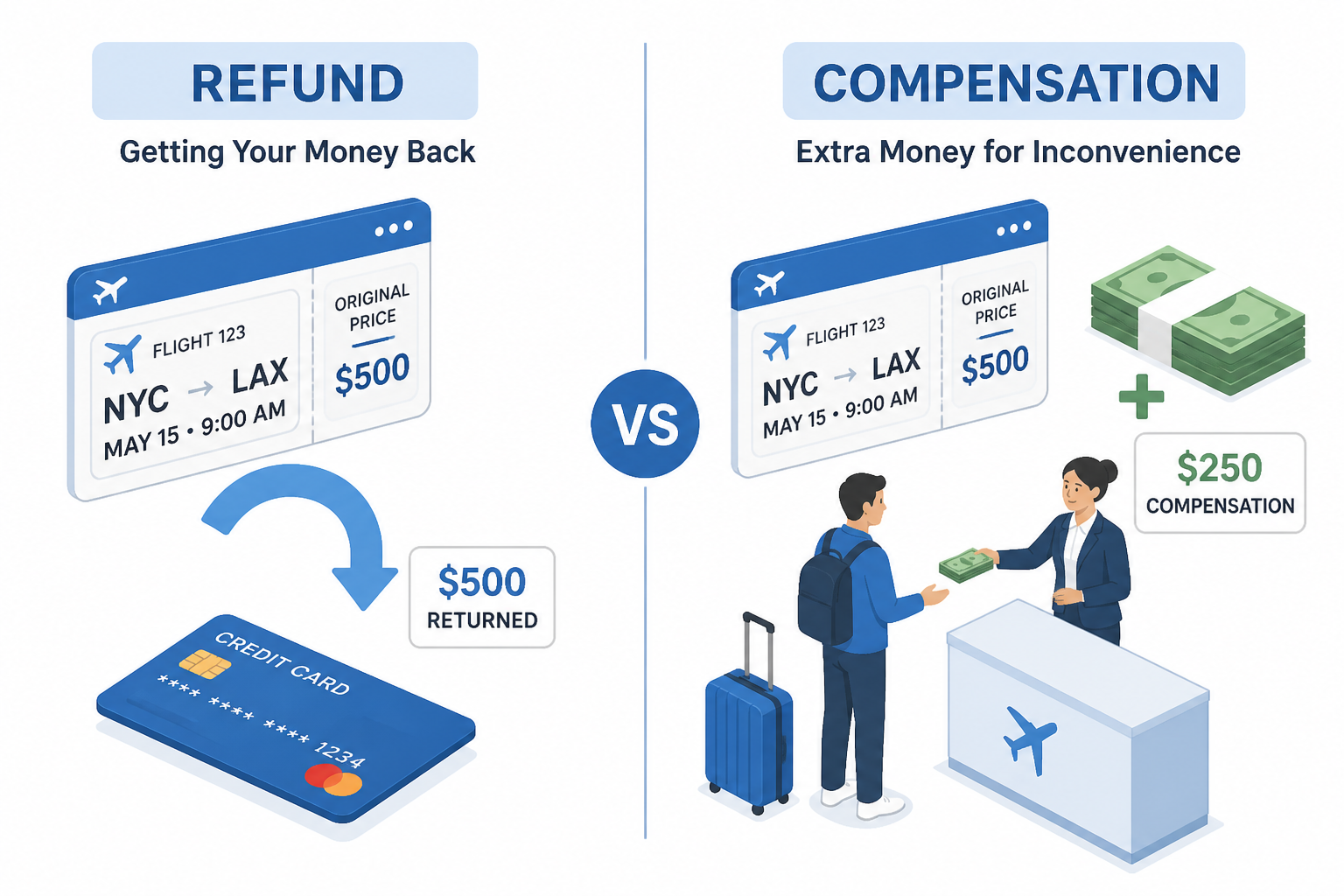
Refund vs. Compensation — They're Not the Same Thing
This is the single biggest point of confusion in air travel rights. A refund and compensation are two completely different things — and you might be entitled to both.
Refund
Compensation
What is it?
Getting your ticket money back
Extra money for your inconvenience
Who pays?
The airline returns what you paid
The airline pays you additional cash
US law (DOT rule)
Yes — mandatory for qualifying delays
No — not required under US law
EU law (EU261)
Yes — for cancellations
Yes — up to €600 per passenger
You must decline rebooking?
Yes (for DOT refund)
No (EU261 compensation is separate)
Typical amount
Full ticket price
€250 to €600, regardless of ticket cost
Refund vs. compensation — you might be entitled to both.
Here's the powerful part: under EU261, you can receive compensation AND still fly on your rebooked flight. The compensation is for the inconvenience, not a replacement for your ticket. In the U.S., however, the DOT rule only guarantees a refund — and only if you choose not to travel.
No U.S. airline is currently required to pay cash compensation for delays. They may offer meal vouchers, hotel rooms, or travel credits voluntarily, but there's no federal law mandating additional compensation beyond getting your money back.
EU261: The Gold Standard for Passenger Compensation
If there's one regulation every traveler should know by heart, it's EU Regulation 261/2004. Often called "EU261," it's the most passenger-friendly flight compensation law in the world — and it applies to more U.S. travelers than you might think.
When EU261 Applies to You
EU261 covers you in two scenarios:
Any flight departing from an EU/EEA/UK airport — on any airline, including U.S. carriers
Any flight arriving at an EU/EEA/UK airport on an EU-based airline
So if you're flying Paris to New York on any airline, you're covered. Flying New York to Paris? Only if you're on an EU-based carrier like Air France or Lufthansa.
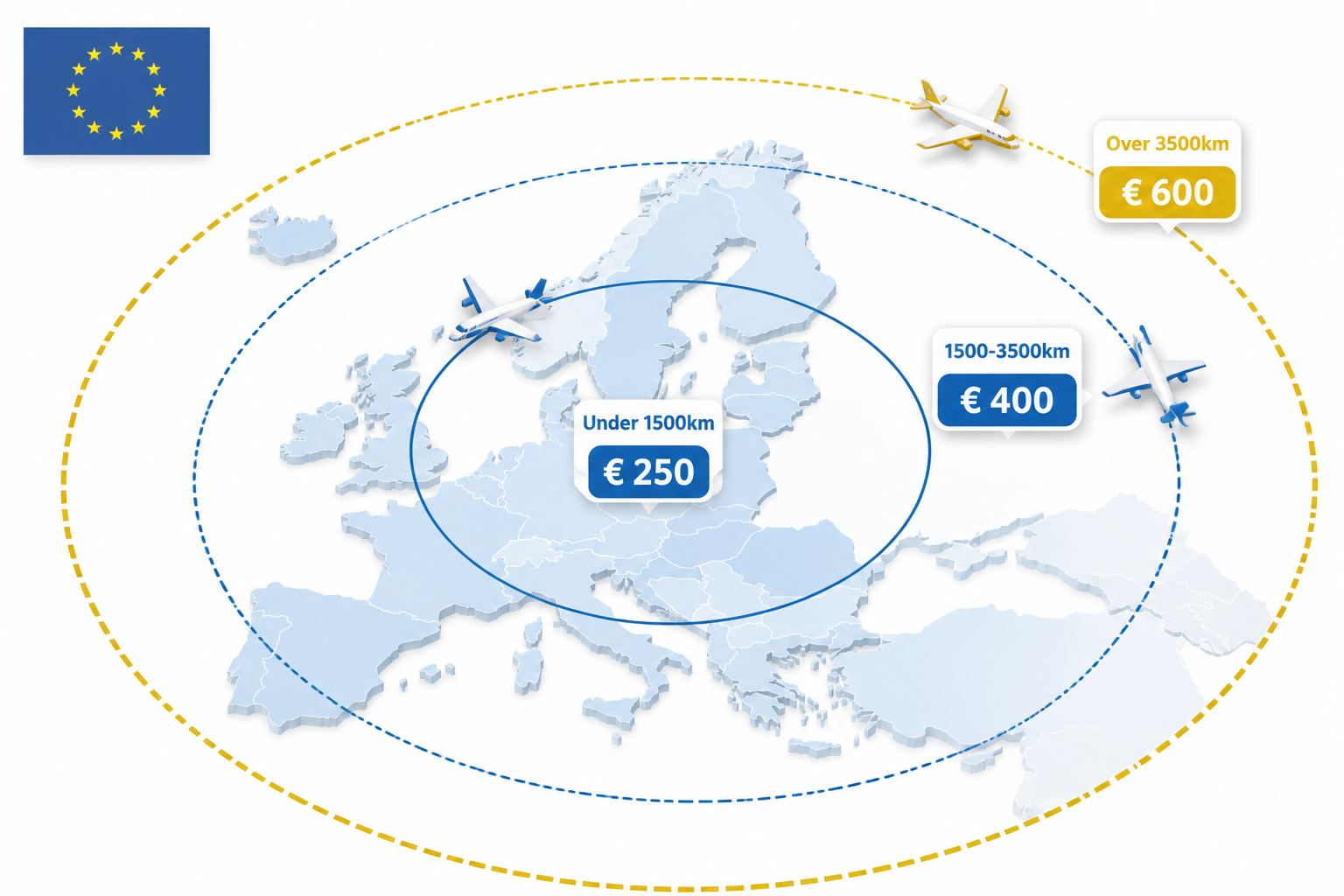
How Much You Can Claim
Flight Distance
Delay at Arrival
Compensation Amount
Up to 1,500 km
3+ hours
€250 (~$275 USD)
1,500 km - 3,500 km
3+ hours
€400 (~$440 USD)
Over 3,500 km
4+ hours
€600 (~$660 USD)
EU261 compensation scales by distance — a transatlantic delay could mean €600 per passenger.
These amounts are per passenger. A family of four on a delayed transatlantic flight? That's potentially €2,400 (about $2,640 USD). And this is on top of any care the airline provides — meals, drinks, hotel rooms, and phone calls are all separate obligations.
The "Extraordinary Circumstances" Exception
Airlines don't have to pay EU261 compensation if the disruption was caused by "extraordinary circumstances" beyond their control. This includes:
Severe weather (thunderstorms, volcanic ash, heavy snow)
Air traffic control restrictions
Security threats
Political instability or strikes by airport staff (but not airline staff strikes — those are within the airline's control)
What doesn't count as extraordinary? Mechanical issues, crew shortages, and IT failures. If the plane broke down or they couldn't find a pilot, you're getting paid.
2026 EU261 Updates
New procedural rules that took effect in February 2026 make it easier for passengers to file and process claims. The European Commission also reached a political agreement in 2025 that may eventually adjust delay thresholds and payout levels — but as of now, the original €250/€400/€600 framework remains fully in force.
U.S. Airline Delay Policies Compared
Since the U.S. doesn't mandate cash compensation for delays, what airlines offer varies wildly. The DOT's Airline Customer Service Dashboard tracks what each carrier has publicly committed to providing during controllable disruptions.
Here's how the major airlines stack up:
Airline
Meal Voucher (3+ hr delay)
Hotel (Overnight)
Rebook on Same Airline
Rebook on Partner
Ground Transport
Delta
Yes
Yes
Yes
Yes
Yes
United
Yes
Yes
Yes
Yes
Yes
American
Yes
Yes
Yes
Yes
Yes
Southwest
Yes
Yes
Yes
N/A (no partners)
Yes
JetBlue
Yes
Yes
Yes
Yes
Yes
Alaska
Yes
Yes
Yes
Yes
Yes
Frontier
Yes
No
Yes
No
No
Source: DOT Airline Customer Service Dashboard. "Controllable" means within the airline's control — crew issues, maintenance, IT problems. Weather delays are excluded.
The big takeaway? All major U.S. airlines now commit to meal vouchers for controllable delays of 3+ hours. And every carrier except Frontier guarantees hotel accommodations for controllable overnight disruptions. But remember — these are voluntary commitments, not legal requirements.
Tracking which airline policies apply to your specific situation is complicated. Book through Autopilot and we'll keep tabs on your reservation details, including schedule changes that might mean you're owed more than a meal voucher.
How to Claim Flight Delay Compensation: Step by Step
Knowing your rights is one thing. Actually getting your money is another. Here's the exact process.
Step 1: Document Everything
The moment your flight is delayed or canceled, start collecting evidence:
Screenshot the departure board showing your delay
Save all notifications from the airline (texts, emails, app alerts)
Keep your boarding pass and booking confirmation
Save receipts for any expenses (meals, hotel, transportation)
Note the reason given for the delay — ask a gate agent if it's not clear
Step 2: Know Which Rules Apply
Domestic U.S. flight delayed 3+ hours? DOT automatic refund rule applies (if you choose not to travel)
International flight delayed 6+ hours? DOT refund rule applies (if you choose not to travel)
Flight departing from an EU airport? EU261 applies — you can claim compensation AND still fly
Flight arriving in the EU on an EU airline? EU261 applies
Step 3: File Your Claim
For DOT refunds: Under the new rule, these should be automatic. If your flight was canceled or significantly delayed and you didn't accept rebooking, the airline must process your refund within 7 business days (credit card) or 20 calendar days (other methods). If the refund doesn't appear, contact the airline's customer service and reference the DOT automatic refund rule.
For EU261 compensation: Visit the airline's website and look for their EU261 claim form. Submit your flight details, booking reference, and a brief description of the disruption. Airlines have no fixed legal deadline to respond, but most will within 4-8 weeks.
If the airline ignores you or denies your claim:
For U.S. issues: File a complaint with the DOT at airconsumer.dot.gov
For EU261 issues: Escalate to the national enforcement body in the country where the disruption occurred (e.g., the CAA in the UK, the DGAC in France)
Step 4: Don't Give Up
Airlines routinely deny valid claims on the first attempt, hoping you'll go away. If your claim is legitimate, push back. Reference the specific regulation (14 CFR Part 260 for DOT rules, or Regulation EC 261/2004 for EU261). Most claims that are escalated get resolved.
Document everything, file promptly, and don't give up if denied.
Credit Card Trip Delay Insurance: Your Hidden Safety Net
Even when airline compensation rules don't apply — like a weather delay on a domestic flight — your credit card might still have your back. Many premium travel cards include trip delay insurance that covers meals, hotels, and other expenses when you're stuck.
Card
Delay Threshold
Max Coverage
Annual Fee
Covers
Chase Sapphire Reserve
6 hours
$500/ticket
$550
Meals, hotel, toiletries, clothing
Amex Platinum
6 hours
$500/trip (2 claims/yr)
$695
Meals, hotel, transportation, essentials
Capital One Venture X
6 hours
$500/ticket
$395
Meals, hotel, toiletries, transportation
Chase Sapphire Preferred
12 hours
$500/person
$95
Meals, hotel, toiletries, medication
Key details to remember:
You must have purchased the flight (or at least a portion of it) on the card
Coverage applies regardless of the reason for the delay — including weather
File your claim within 60 days (for most issuers) with receipts
Coverage extends to the cardholder and often their spouse and dependents
This is the real hidden gem. Your airline won't compensate you for a thunderstorm delay. But if you booked on a Chase Sapphire Reserve and your flight was delayed 6+ hours, you can claim up to $500 in expenses — no questions about who caused the delay.
What the Airlines Don't Want You to Know
After years of covering this space, here are the insider tips that actually make a difference:
1. "Controllable" is the magic word. Airlines only owe you meals and hotels when the delay is within their control — crew issues, mechanical problems, IT outages. If they blame weather, ask specifically: "Is this delay classified as controllable or uncontrollable in your system?" Sometimes a "weather" delay is actually a crew shortage caused by earlier weather.
2. The DOT refund is yours even if you rebook later. If you initially decline rebooking and request your refund, the airline must process it. You can then book a completely separate ticket (potentially at a lower price) on your own.
3. EU261 claims are valid for years. Depending on the country, you may have anywhere from 1 to 6 years to file an EU261 claim. In the UK, it's 6 years. In France, it's 5 years. Dig through your old boarding passes — you might be sitting on money.
4. You can stack protections. There's nothing stopping you from collecting a DOT refund, filing an EU261 compensation claim, AND submitting your expense receipts to your credit card's trip delay insurance. These are three separate protections covering three different things.
5. Gate agents can override policies. Politely asking a gate agent for a meal voucher or lounge access during a long delay often works even when official policy says otherwise. Agents have discretion — use it.
6. Always get the reason in writing. Ask the airline for written confirmation of the delay cause. This is critical for EU261 claims where the airline might later try to claim "extraordinary circumstances."
The reality is that most passengers leave money on the table because they don't know the rules — or they assume the airline will do the right thing automatically. Autopilot tracks your flights automatically, so if your airline owes you money, you'll know about it before the airline hopes you've moved on.
Frequently Asked Questions
How long does a flight have to be delayed for compensation?
It depends on the regulation. Under U.S. DOT rules, a domestic flight delayed 3+ hours or an international flight delayed 6+ hours qualifies for an automatic cash refund (if you choose not to travel). Under EU261, any eligible flight arriving 3+ hours late at its final destination qualifies for compensation of €250 to €600, regardless of whether you still fly.
Do I get compensation for weather delays?
Generally, no. Both DOT refund rules and EU261 compensation have exceptions for weather and other events outside the airline's control. However, your DOT refund right still applies if the delay exceeds the threshold — regardless of cause — as long as you decline rebooking. And credit card trip delay insurance typically covers weather delays too.
Can I get both a refund AND compensation?
Yes, in certain situations. Under EU261, you can receive compensation for the inconvenience AND a refund of your ticket if you choose not to travel. In the U.S., you can receive a DOT refund and separately claim credit card trip delay insurance for expenses incurred during the delay.
Do the DOT refund rules apply to flights on foreign airlines?
Yes. The DOT automatic refund rule applies to all flights departing from or arriving in the United States, regardless of the airline's country of origin. If you're flying on a foreign carrier and the flight departs from or arrives at a U.S. airport, you're covered.
What if the airline offers me a voucher instead of a refund?
Under the DOT rule, the airline must offer a cash refund first. They may also offer a voucher or credit as an alternative, but they cannot pressure you into accepting it. If you want cash, you're entitled to cash. The voucher must also be valid for at least 5 years and transferable.
How do I file an EU261 claim from the United States?
Start by submitting a claim directly to the airline through their website — most have an EU261 or "flight disruption" claim form. Include your booking reference, flight number, and dates. If the airline denies your claim or doesn't respond within a reasonable time (typically 8 weeks), escalate to the national enforcement body in the country where the disruption occurred.
Is there a time limit for filing a flight delay compensation claim?
For EU261 claims, the statute of limitations varies by country: 6 years in the UK, 5 years in France, 3 years in Germany, and 2 years in Spain. For DOT refunds, there's no specific filing deadline, but you should act promptly — ideally within 7 days of the disruption. For credit card trip delay insurance, most issuers require you to file within 60 days.
Do budget airlines have to follow the same rules?
Absolutely. The DOT automatic refund rule applies to all airlines operating flights to, from, or within the United States — including budget carriers. EU261 applies to all airlines on flights departing from EU airports, and to EU-based airlines on flights arriving in the EU. Budget airline or not, the law is the law.
The Bottom Line
Flight delays are frustrating. But they don't have to be expensive — at least, not for you.
Between DOT automatic refunds, EU261 compensation, airline voluntary policies, and credit card trip delay insurance, the average traveler has more protections than ever. The key is knowing which rules apply to your specific situation and being prepared to assert your rights.
Document everything. Know the thresholds. File your claims promptly. And don't accept a $10 meal voucher when you're owed a full refund.
Book with Autopilot and let us monitor your flights for schedule changes, delays, and cancellations that could trigger refund eligibility. Because the best time to know your rights is before you need them.
Disclaimer: This article is for informational purposes only and should not be considered legal advice. Regulations and airline policies may change. Always verify directly with the airline or relevant authority.