

First Time Flying? Here's Exactly What to Expect at Every Step (2026 Guide)
Flying for the first time? This 2026 guide covers every step from check-in to landing, plus REAL ID rules, bag fees, and mistakes to avoid.

Flying for the first time? This 2026 guide covers every step from check-in to landing, plus REAL ID rules, bag fees, and mistakes to avoid.
Your first flight can feel overwhelming. Between bag fees, security lines, and boarding zones, there's a lot to figure out — and most of it isn't intuitive.
This guide walks you through every single step, from booking your ticket to picking up your bags on the other end. No fluff, no jargon, just exactly what to expect so you can walk into that airport like you've done it a hundred times.
Let's get into it.
If this is your very first time flying, do yourself a favor and book a nonstop flight. Connecting flights add complexity — tight layovers, gate changes, the stress of sprinting through an unfamiliar airport. You can tackle connections once you've got one flight under your belt.
When you're ready to book, Autopilot makes it easy to search and compare flights without the headache of juggling multiple airline sites.
Most airlines open online check-in exactly 24 hours before your departure time. Do it immediately. This confirms your seat assignment, and for some airlines, checking in early gives you a better boarding position.
You'll get the option to download a mobile boarding pass to your phone or print a paper one. Either works — but screenshot your mobile pass in case you lose cell signal at the airport. It happens more often than you'd think.
Every airline lets you bring one personal item (backpack, purse, laptop bag) that fits under the seat in front of you. Most also allow a full-size carry-on for the overhead bin — though basic economy fares on some carriers don't include this.
For your carry-on, pack essentials you can't afford to lose: medications, phone charger, a change of clothes, travel documents, and valuables. For your checked bag, pack everything else — but know that checked bags can (rarely) get delayed or lost.
One critical rule: liquids in your carry-on must follow the 3-1-1 rule. Each container must be 3.4 ounces (100 ml) or smaller, all containers must fit in one quart-sized clear zip-top bag, and each passenger gets one bag. Full-size shampoo and toothpaste go in the checked bag.
The standard advice exists for a reason:
That buffer accounts for check-in lines, security wait times, and the walk to your gate — which can be surprisingly long at major airports. Being early is boring. Missing your flight is expensive.
Large airports have multiple terminals, and each airline typically operates out of a specific one. Check your booking confirmation or the airport's website before you leave home. Getting dropped at the wrong terminal means a shuttle ride or a long walk before you even start.
If someone is driving you, curbside drop-off at the departures level is the easiest option — pull up, grab your bags, walk inside. If you're driving yourself, budget an extra 15-20 minutes for parking and the shuttle to the terminal.
If you already checked in online (you did, right?), head straight to the bag drop counter if you have a checked bag. If you didn't check in online, look for the self-service kiosks — touch screens where you enter your confirmation number or scan your ID to print your boarding pass and bag tags.
At the bag drop counter, an agent will weigh your checked bag (50 lbs max for most airlines), attach the routing tag, and send it on its way. You'll get a claim receipt — keep it. That's your proof if the bag goes missing.
Checked bags aren't free on most airlines. Here's what you'll pay for the first checked bag in 2026:
| Airline | 1st Checked Bag (Prepaid Online) | 1st Checked Bag (At Airport) |
|---|---|---|
| Delta | $45 | $50 |
| United | $45 | $50 |
| American | $45 | $50 |
| Southwest | $45 | $50 |
| JetBlue | $39–$49 | $49–$59 |
| Spirit | $35–$55 | $55–$65 |
Fees vary by route, season, and when you pay. Always prepay online — it's cheaper every time.
If you're trying to avoid bag fees entirely, pack light and stick with a carry-on. It's a skill worth developing.
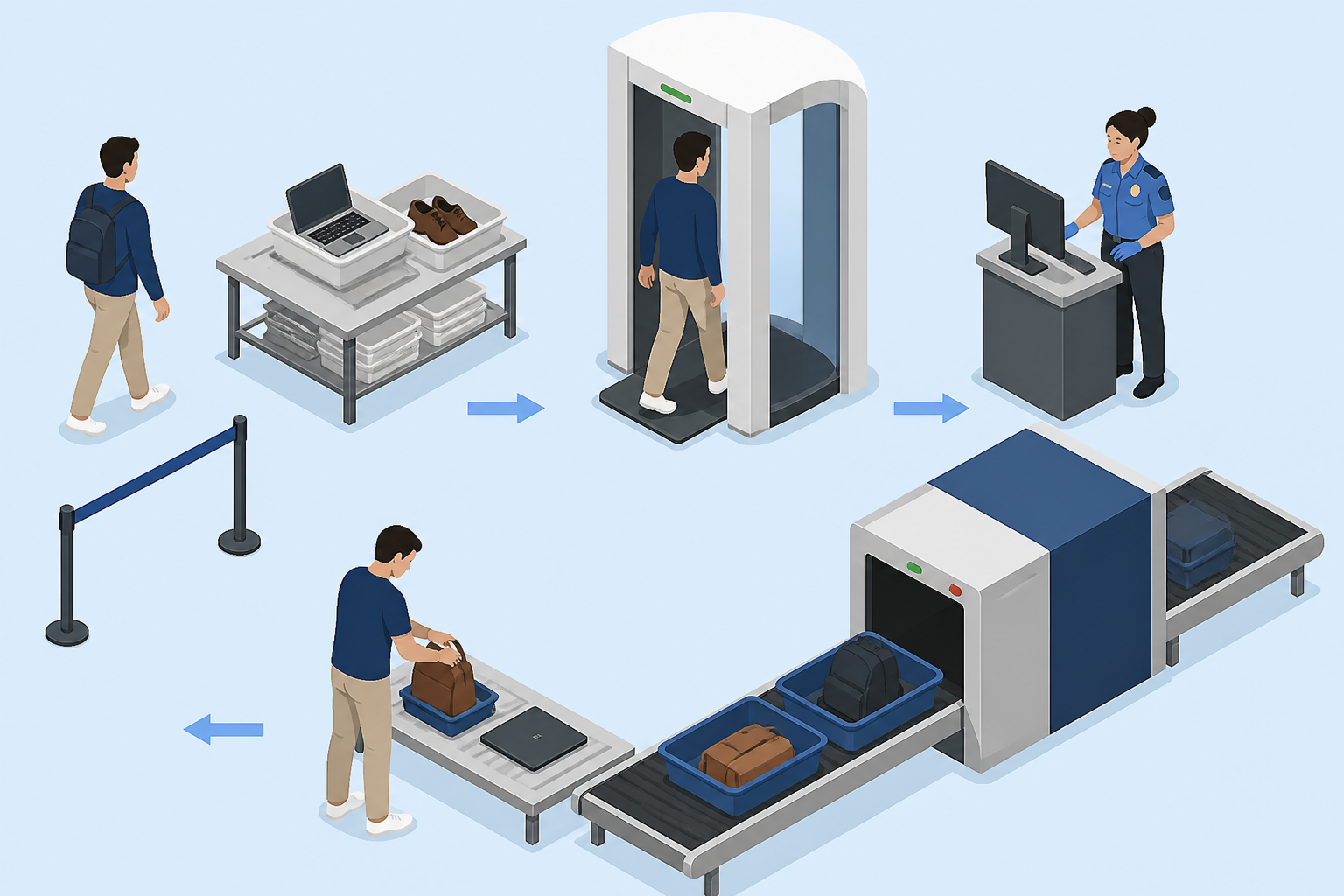
Security is the part most first-time flyers stress about. Here's the truth: it's straightforward once you know the drill.
You need two things: your boarding pass (mobile or paper) and your government-issued photo ID. A TSA officer will check both before you enter the screening area.
Important 2026 update: REAL ID is now enforced. Your driver's license needs to have the star marking in the upper corner to be accepted. If it doesn't, you'll need a U.S. passport, passport card, or another approved ID. Show up without compliant ID and you'll face a $45 ConfirmID fee and potential delays of 30 minutes or more.
This trips people up. You cannot bring these in your carry-on: knives, scissors longer than 4 inches, lighters (one disposable lighter is allowed), large bottles of liquid, aerosol cans over 3.4 oz, or anything that looks weapon-like. When in doubt, pack it in your checked bag or leave it at home.
If your state supports it, you can now add your driver's license to Apple Wallet, Google Wallet, or Samsung Wallet and use it at TSA checkpoints across 250+ airports. As of June 2026, 14 states plus Puerto Rico support this feature. Just tap your phone at the identity verification podium — no need to hand anything to an agent.
Once through security, you're "airside." Now find your gate.
Look for the departure screens — large monitors listing every outgoing flight with its gate number, departure time, and status. Your gate is also on your boarding pass, but always double-check the screens. Gate changes happen frequently and your boarding pass won't update automatically.
This is one of the most common mistakes first-time flyers make. Your departure time is when the plane is scheduled to leave the gate. Boarding starts 30-45 minutes before that.
If your flight departs at 3:00 PM, boarding might begin at 2:15 PM. You should be at the gate and ready by then. Miss the boarding window and the gate agent can give your seat away — even if the plane hasn't left yet.
Airlines board passengers in waves, not all at once. Your boarding pass will show a zone or group number. Group 1 boards first (usually first class, business class, and elite frequent flyers), and the numbers go up from there.
When the gate agent announces your group, line up at the scanner, scan your boarding pass, and walk down the jet bridge to the plane. Don't be the person who crowds the gate during Group 1 when they're in Group 5.
You're on the jet bridge. Here's what happens next.
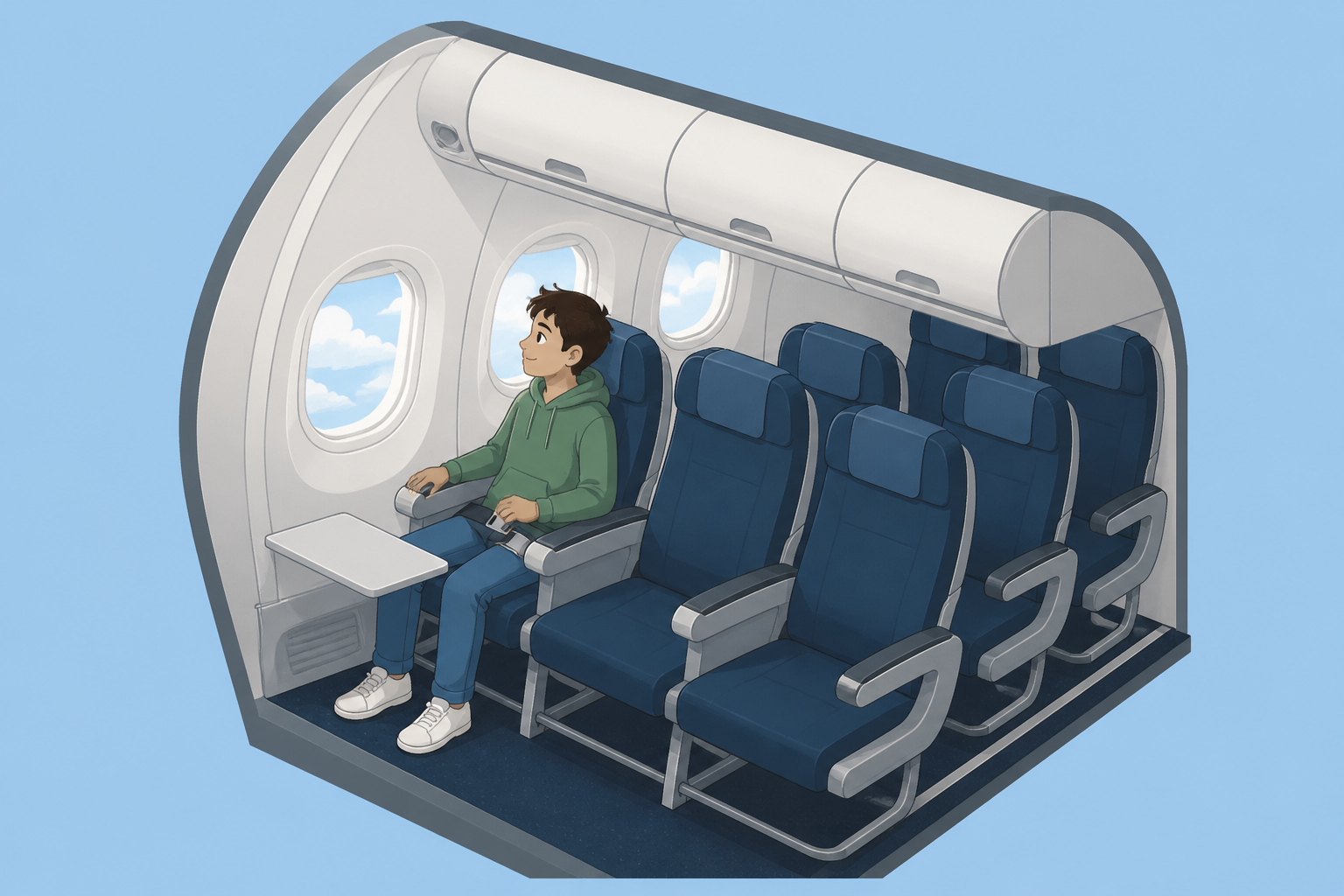
Walk onto the plane, glance at the row numbers above the seats, and find yours. Rows are numbered from front to back, and seats are lettered from left to right (A is the window on the left, and the last letter — usually F on a narrow-body — is the window on the right).
Open the overhead bin above your row, place your bag wheels-first with the handle facing out, and close it. Your personal item goes under the seat in front of you. If the overhead bins near your seat are full, a flight attendant will help you find space — or gate-check your bag for free.
Window seat gets the wall and the view. Aisle seat gets the legroom and easy bathroom access. Middle seat gets both armrests. This is the unspoken social contract of flying, and seasoned travelers respect it.
Buckle your seatbelt (low and tight across your hips), stow your tray table, and make sure your seat is upright. The flight attendants will do a safety demonstration — watch it your first time. It covers exit locations, oxygen masks, and life vest procedures.
During takeoff and landing, you'll feel pressure building in your ears as the cabin pressure changes. This is completely normal. To relieve it: chew gum, yawn, swallow frequently, or try the Valsalva maneuver (pinch your nose, close your mouth, and gently blow). It works almost instantly.
If you're congested, take a decongestant before the flight. Blocked sinuses make ear pressure significantly worse.
The plane will shake sometimes. It might shake a lot. Turbulence is normal and not dangerous. Think of it like driving over a bumpy road — uncomfortable, but the plane is built to handle far more than anything you'll ever experience.
Keep your seatbelt fastened whenever you're seated, even when the sign is off. That way you're protected if the plane hits unexpected rough air.
You can use your phone, tablet, and laptop for the entire flight — just switch to airplane mode during taxi, takeoff, and landing (most airlines now allow it gate-to-gate as long as airplane mode is on). Many flights offer Wi-Fi for purchase, and some airlines include free streaming entertainment through their app.
The bathroom is small. Very small. The door locks by sliding a latch — this also turns on the light. Wait until the seatbelt sign is off before getting up. A green "vacant" indicator on the door means it's empty; red means occupied. And please — don't try to use it during meal service when the cart is blocking the aisle.
About 30 minutes before landing, the captain will announce the initial descent. The seatbelt sign comes back on. Tray table up, seat upright, personal items stowed.
After the plane lands and reaches the gate, the seatbelt sign turns off with a ding. Here's the etiquette: passengers deplane row by row, front to back. Don't leap over three rows to get ahead. It doesn't actually save time, and it annoys everyone.
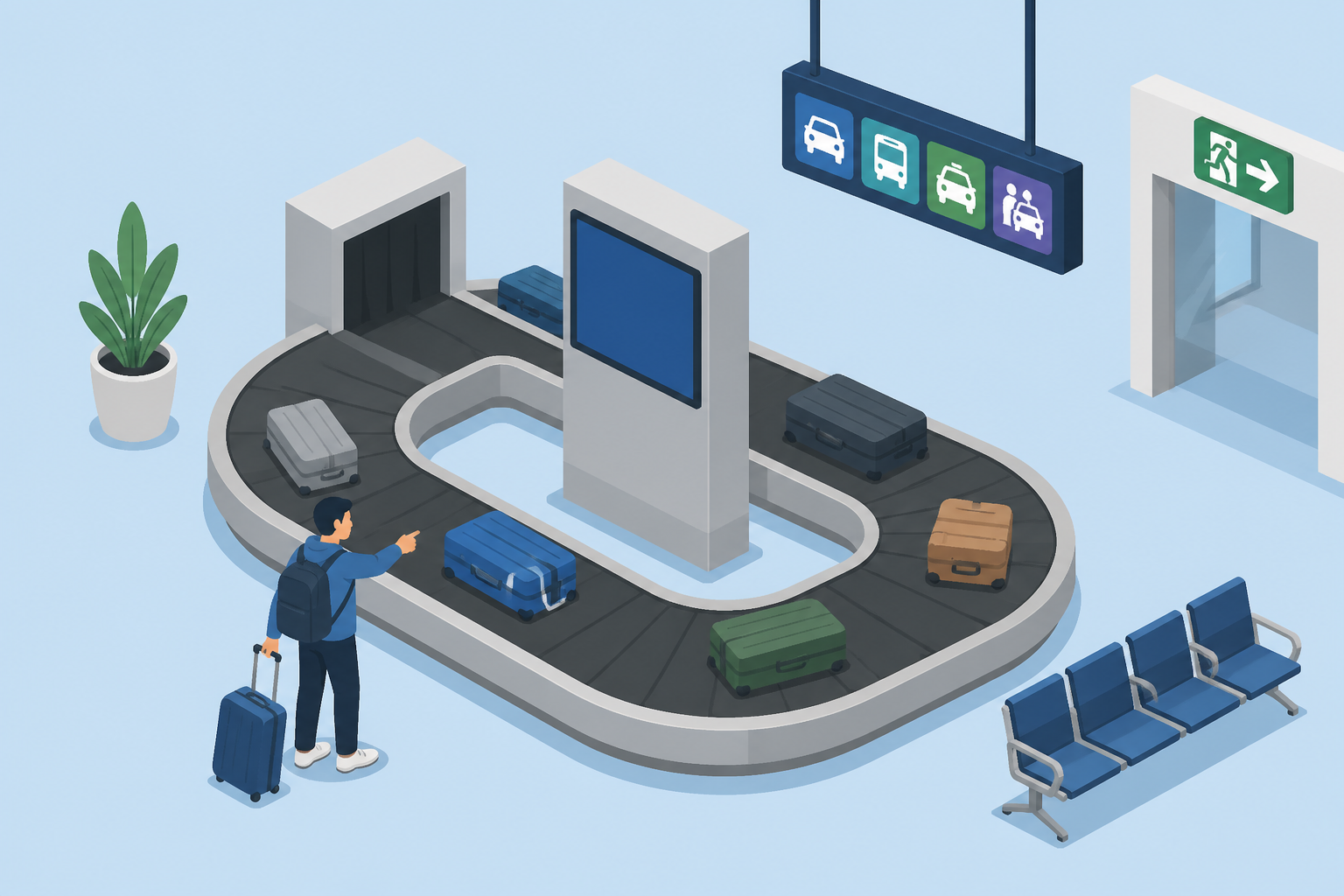
If you checked a bag, follow signs to baggage claim. Screens will show which carousel your flight's bags are on. It usually takes 15-30 minutes for bags to appear. Grab yours, double-check the name tag to make sure it's actually yours, and you're done.
If you're arriving from an international flight, you'll go through passport control (have your passport ready), then collect your bags, then walk through customs. In most cases, you'll have nothing to declare and it's a quick walk-through. Fill out any declaration forms the flight attendants hand out before you land — it saves time.
Follow signs to ground transportation for taxis, rideshare pickup, rental cars, or hotel shuttles. Most airports have a designated rideshare pickup zone — check the app for the exact location. If someone is picking you up, head to the arrivals level curbside.
A few important things have changed recently:
Planning your first trip? Search flights on Autopilot and let us handle the comparison shopping so you can focus on the exciting part — the trip itself.
Arrive at least 2 hours before a domestic flight and 3 hours before an international flight. As a first-time flyer, the extra buffer gives you time to navigate check-in, security, and finding your gate without rushing. If you're flying during peak travel season (summer, holidays), add an extra 30 minutes.
Yes. Solid food items are allowed through TSA security in your carry-on. Sandwiches, granola bars, fruit, chips — all fine. The only restriction is on liquids and gels, which must follow the 3-1-1 rule (3.4 oz containers in a quart-sized bag). So a sealed water bottle won't make it through, but a bag of trail mix will.
Contact the airline immediately — either at the airport counter or by phone. Most airlines will rebook you on the next available flight, though policies vary. Refundable and flexible tickets are usually rebooked at no charge. Basic economy and non-refundable tickets may require a fee or a new ticket purchase. The earlier you notify the airline, the better your options.
Not necessarily, but you need a REAL ID-compliant driver's license (look for the star marking) or another TSA-approved form of identification. A U.S. passport always works for domestic flights and is the simplest backup if your license isn't REAL ID compliant. For international flights, you absolutely need a passport.
No. Turbulence is a normal part of flying caused by air currents, weather patterns, and jet streams. Modern aircraft are engineered to withstand turbulence far beyond what passengers ever experience. The biggest risk from turbulence is injury from not wearing your seatbelt — which is why you should keep it loosely fastened whenever you're seated.
Yes, as long as it's in airplane mode. Most airlines allow gate-to-gate use of personal electronic devices with airplane mode enabled. Many flights offer purchasable Wi-Fi, and some airlines provide free in-flight entertainment through their app. You can stream, read, listen to music, or work offline for the entire flight.
Go to the airline's baggage service office, usually located near the baggage claim area. Show them your bag claim receipt (the sticker they gave you at check-in). They'll track your bag and arrange delivery to your hotel or home — most delayed bags are returned within 24 hours. This is why you should always pack essentials in your carry-on.
Your boarding group (or zone) is printed on your boarding pass — both the paper version and the mobile version. It's usually labeled "Group," "Zone," or "Boarding" followed by a number. Lower numbers board first. Listen for the gate agent to call your group before lining up. If you're unsure, just ask the gate agent — they're happy to help.
Flying for the first time is genuinely exciting once you strip away the anxiety. And now that you know exactly what to expect at every step — from curbside to baggage claim — there's nothing left to stress about.
Search flights on Autopilot to find the best options for your first trip. We'll show you what's available across airlines so you can pick the perfect flight and get to the fun part — actually going somewhere new.
Disclaimer: Some of the information in this article may be outdated as airline and travel policies change frequently. Always verify details directly with the relevant airline or provider before making travel decisions.

