

The Only Europe Packing List You Actually Need (2026 Guide)
What to pack for Europe in 2026 — a complete carry-on packing list with clothing, shoes, tech, toiletries, seasonal tips, airline bag limits, and anti-theft advice.

What to pack for Europe in 2026 — a complete carry-on packing list with clothing, shoes, tech, toiletries, seasonal tips, airline bag limits, and anti-theft advice.
You don't need half the stuff you think you do.
Every seasoned traveler will tell you the same thing: their best European trip was the one where they packed the least. And yet, every first-timer still shows up at the airport with a 50-pound checked bag and a "personal item" the size of a small refrigerator.
Here's everything you actually need for Europe — and more importantly, what you can leave at home.
Europe is not a wilderness expedition. It's a continent with pharmacies on every corner and shops in every city. If you forget something, you can buy it there.
The real cost of overpacking isn't the checked bag fee (though that stings). It's the physical toll — cobblestone streets, train platforms with no elevators, walk-up apartments, narrow aisles on budget airlines. Every extra pound you pack is a pound you'll curse.
My rule: lay out everything you want to bring, then remove half of it. You'll still have too much.
Before you start packing, make sure you've got the best deal on your flight. Autopilot monitors prices after you book and automatically helps you save — so you can put that money toward a nicer hotel instead of a second checked bag.
This list is designed for a 10-to-14-day trip, carry-on only. Adjust quantities up or down based on your trip length, but the categories stay the same whether you're gone for a week or a month.
| Item | Quantity | Notes |
|---|---|---|
| T-shirts / tops | 4–5 | Merino wool or quick-dry blends; they resist odor and dry fast |
| Long-sleeve layer | 1–2 | Button-down or lightweight sweater for dinners and churches |
| Pants / trousers | 2 | One pair dark jeans or chinos, one pair lightweight travel pants |
| Shorts or skirt | 1–2 | Summer only; skip for winter trips |
| Light jacket | 1 | Packable rain jacket or windbreaker — non-negotiable |
| Warm mid-layer | 1 | Fleece or packable down; shoulder season and winter |
| Underwear | 5–6 | Quick-dry fabric means you can hand-wash and rotate |
| Socks | 4–5 pairs | Merino wool hiking socks are worth the investment |
| Swimsuit | 1 | Even for city trips — hotel pools, thermal baths, unexpected beaches |
| Sleepwear | 1 set | Doubles as loungewear for the flight |
Pro tip: Stick to a color palette of 2–3 neutral tones (black, navy, olive, grey) so everything mixes and matches. Europeans tend to dress in muted, put-together outfits. You'll blend in better and get more mileage from fewer pieces.
Shoes are the single biggest packing trap. They're heavy, bulky, and impossible to compress. Three pairs is the maximum. Two is better.
| Shoe | Purpose | Key Feature |
|---|---|---|
| Walking shoes | Daily exploring (10+ miles/day) | Broken-in, supportive, cobblestone-friendly |
| Dress shoes or sandals | Nice dinners, evening strolls | Comfortable enough for light walking |
| Flip-flops or slides | Hostel showers, pool, flights | Lightweight, packable |
Leave the stilettos, chunky wedges, and brand-new sneakers at home. Europe's cobblestone streets will destroy impractical footwear and your feet along with them. Break in your walking shoes before the trip — blisters on day one can sideline your entire itinerary.
Pack the minimum. Europe has pharmacies (often better-stocked than American drugstores) on practically every block.
| Item | Notes |
|---|---|
| Toothbrush + toothpaste | Travel-size toothpaste (under 100ml / 3.4oz) |
| Deodorant | Solid stick to avoid liquid restrictions |
| Sunscreen (SPF 50) | Essential May through September, even in Northern Europe |
| Prescription medications | Bring more than you need + keep originals in labeled bottles |
| Basic first aid | Band-aids, antiseptic wipes, pain relief, blister plasters |
| Shampoo / conditioner | Solid bars save space and skip liquid rules entirely |
| Contact lens supplies | If applicable; bring enough solution for the full trip |
| Razor | Disposable or safety razor (pack in carry-on per TSA rules) |
Liquid rules: Most European airports enforce the 100ml (3.4oz) per container limit. A growing number of airports — including Rome Fiumicino, Dublin, and Prague — now allow up to 2 liters thanks to new CT scanners, but the rollout is uneven. Pack to the 100ml standard and you'll never have an issue.
| Item | Notes |
|---|---|
| Phone + charger | Your single most important tool — maps, translation, boarding passes |
| Plug adapter (Type C/F) | Covers 95% of continental Europe; add Type G for UK/Ireland |
| Portable battery pack | 20,000mAh minimum; 15,000+ steps per day drains your phone fast |
| eSIM or local SIM | eSIM is the clear winner — instant activation, covers 35-40 countries, no SIM swapping |
| Noise-canceling headphones | Long flights, train rides, hostel dorm rooms |
| Kindle or e-reader | Optional but lighter than carrying physical books |
| Camera | Optional — your phone is probably good enough |
Adapter tip: Europe runs on 230V/50Hz — double the US voltage. Modern phones, laptops, and camera chargers are dual-voltage (check for "100–240V" on the label), so you only need a plug adapter, not a voltage converter. Never plug in a US-only hair dryer or curling iron without checking.
eSIM vs. physical SIM: In 2026, eSIMs are the clear winner. Providers offer plans covering 35–40 European countries with instant digital activation. Scan a QR code before you leave and you'll have data the moment you land — no hunting for SIM card shops at the airport.
| Item | Notes |
|---|---|
| Passport | Valid for 6+ monthsbeyond travel dates; check expiration NOW |
| ETIAS authorization | Required for US citizens starting Q4 2026 (~$23); apply online before departure |
| Travel insurance docs | Print a copy and save digitally; some countries require proof |
| Credit card (no FTF) | Visa and Mastercard accepted almost everywhere; carry 2 from different banks |
| Debit card | For ATM withdrawals; notify your bank before departure |
| Cash (euros) | ~€100 equivalent as backup; Eastern Europe may use local currency |
| Digital copies | Photograph your passport, insurance, and cards; store in secure cloud app |
Heads up on ETIAS: The European Travel Information and Authorization System launches in late 2026. US citizens will need to apply online (takes minutes, costs ~$23) before departure. Valid for three years. Keep it on your radar.
| Item | Notes |
|---|---|
| Carry-on bag (40L max) | Backpack or rolling bag that meets airline size limits |
| Packable daypack | Folds flat for daily sightseeing |
| Packing cubes | Game-changer for organization; compression cubes save even more space |
| Laundry bag | Separate dirty clothes from clean ones |
| Zip-lock bags | Wet swimsuit, leaky toiletries, snacks — endlessly useful |
This section might save you more space than the entire packing list above.
A hair dryer or curling iron. Nearly every European hotel and Airbnb provides one. And unless yours is dual-voltage (most aren't), you risk frying it — or worse, starting a fire — the moment you plug it in.
More than three pairs of shoes. I know it's tempting. Resist. Your back and your suitcase will thank you.
A full-size towel. Hotels provide them. Hostels usually rent them for a couple of euros. If you're worried, pack a quick-dry microfiber towel that weighs almost nothing.
Too many "just in case" outfits. You will not attend a surprise gala in Florence. You will not need seven different dinner outfits. Pack versatile pieces that work across multiple settings.
Bulky cotton everything. Cotton is heavy, slow to dry, and miserable when wet. Merino wool and synthetic blends are lighter, dry faster, and resist odors longer.
Guidebooks. They're heavy and outdated the moment they're printed. Use your phone instead.
Excessive snacks from home. Europe has grocery stores, bakeries, and markets on every corner. You'll eat better and cheaper buying local.
Flying a European budget carrier with strict bag limits? Book through Autopilot and compare baggage policies across airlines so you know exactly what you're getting before you pay.
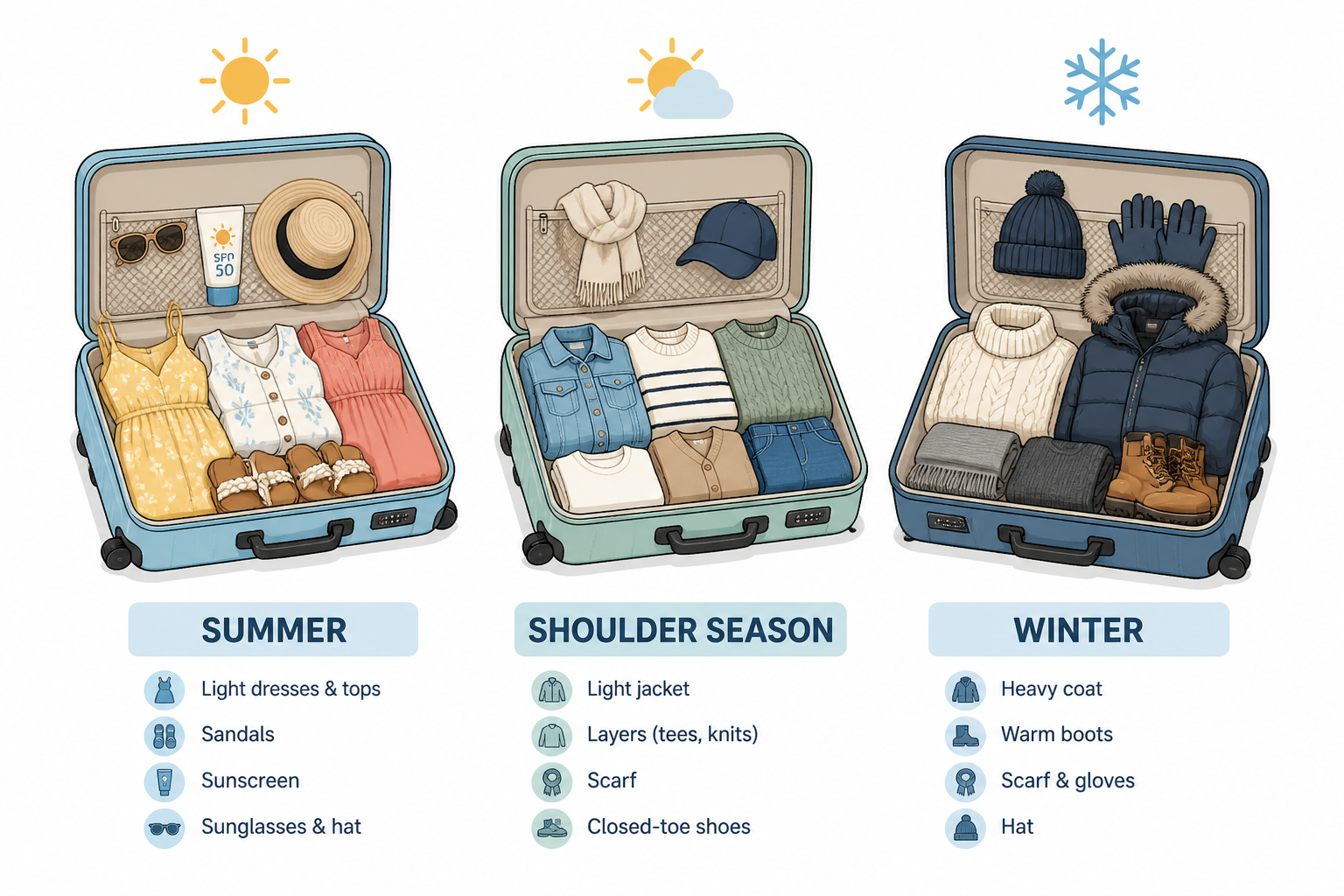
Europe's weather varies wildly by region and month. Here's how to adjust your packing based on when you're going.
| Category | Summer (Jun–Aug) | Shoulder (Apr–May, Sep–Oct) | Winter (Nov–Mar) |
|---|---|---|---|
| Tops | Light tees, tanks, linen | Mix of tees + long sleeves | Thermal base layers + sweaters |
| Bottoms | Shorts, light pants, skirts | Pants, one pair of shorts | Warm pants, thermals underneath |
| Outerwear | Packable rain jacket | Rain jacket + light fleece | Waterproof parka + insulated layer |
| Shoes | Breathable walking shoes + sandals | Waterproof walking shoes + dress shoes | Waterproof boots + warm socks |
| Accessories | Sunglasses, sunhat, SPF | Sunglasses, light scarf | Gloves, wool hat, warm scarf |
| Key add | Swimsuit, cover-up | Packable umbrella | Hand warmers, thermal leggings |
| Temps | 70–95°F / 21–35°C | 50–70°F / 10–21°C | 25–50°F / -4–10°C |
Regional note: Mediterranean Europe (southern Italy, Greece, Spain, Croatia) runs 10–15°F warmer than Northern Europe (Scandinavia, UK, Netherlands) in every season. If your trip spans multiple regions, pack for the coldest destination and layer down.
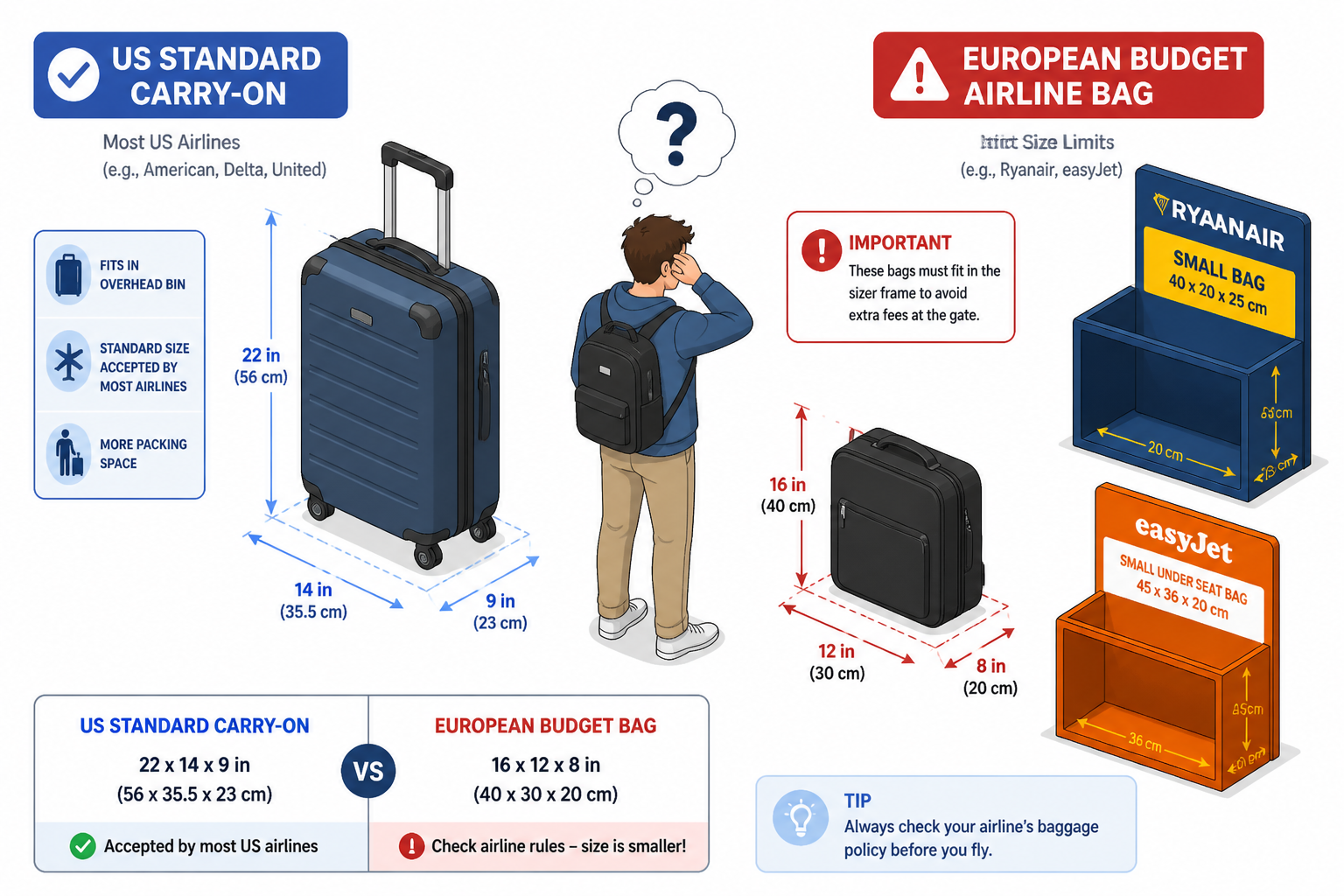
This is where things get tricky. European budget carriers are significantly more restrictive than US airlines, and they enforce their rules aggressively. Get this wrong and you'll pay €40–70 at the gate — more than the flight itself in some cases.
| Airline | Free Bag | Overhead Bin Bag | Notes |
|---|---|---|---|
| Ryanair | 40 × 20 × 25 cm | 55 × 40 × 20 cm (Priority only) | Free bag goes under seat; overhead access requires Priority Boarding add-on |
| EasyJet | 45 × 36 × 20 cm | 56 × 45 × 25 cm (Standard+ / FLEXI) | Cheapest "Essential" fares: under-seat bag only |
| Wizz Air | 40 × 30 × 20 cm | 55 × 40 × 23 cm (WIZZ Priority) | Free bag is tiny — basically a personal item |
| Vueling | 40 × 20 × 30 cm | 55 × 40 × 20 cm (Optima / TimeFlex) | Basic fare: under-seat bag only |
| US major carriers | Personal item | 56 × 36 × 23 cm (22 × 14 × 9 in) | Full-size carry-on included with most fares |
The takeaway: If you're hopping around Europe on budget carriers, your carry-on needs to fit in that tiny under-seat space (roughly the size of a large backpack). Measure your bag before you go. Ryanair gate agents measure with ruthless precision.
Planning intra-Europe flights? Autopilot lets you compare fares across carriers — including what's actually included in the ticket price — so there are no surprises at the gate.
The secret weapon of every light packer? Laundry. If you're willing to wash clothes once or twice during a two-week trip, you can cut your clothing in half.
Hand-washing in the sink. Wash socks, underwear, and light tops in the sink at night with travel laundry soap. They'll be dry by morning if you wring them well and hang near a window. Quick-dry fabrics are essential here.
Laundromats. Available in most Western European cities (less common in Eastern Europe). Budget €8–12 per load. Takes about an hour. Great for mid-trip resets.
Hotel laundry service. Convenient but expensive — expect €30–50 per load. Save this for emergencies.
Drop-off wash-and-fold. The sweet spot. Many laundromats offer this: drop off in the morning, pick up clean and folded in the evening. Usually charged by the kilo.
The formula: For a 14-day trip, pack 7 days of underwear and socks, 5 tops, and 2 bottoms. Do one sink wash around day 4–5 and one laundromat visit around day 8–9. You'll always have clean clothes and your bag stays light.
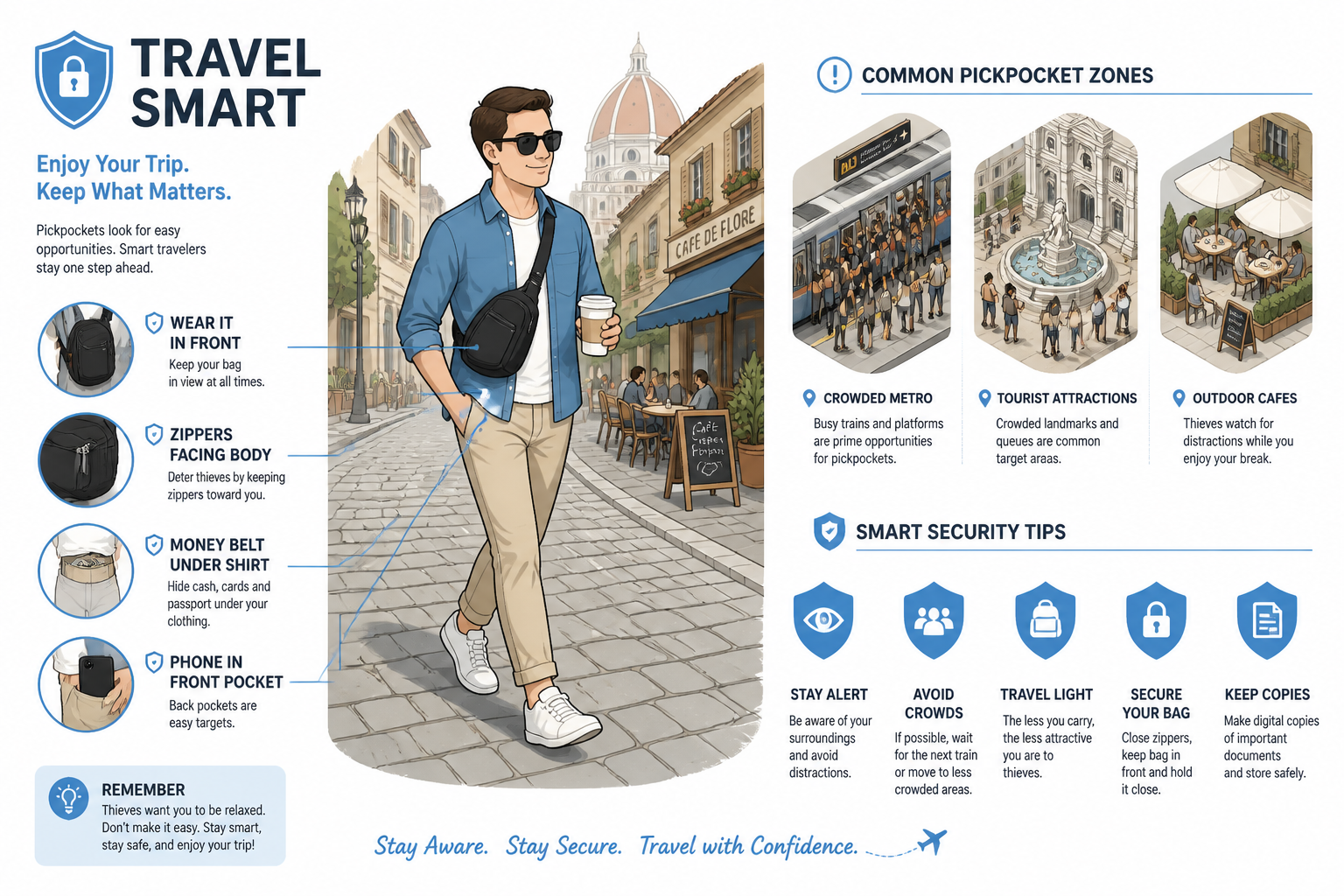
Europe is safe. But pickpocketing is a professional sport in certain tourist-heavy cities, and Americans are prime targets because we carry everything in back pockets and open handbags.
High-risk zones: The Paris Metro, Las Ramblas in Barcelona, the Trevi Fountain in Rome, Prague's Old Town Square, and crowded transit hubs. Organized teams work in groups — one distracts while another reaches into your bag.
Bag strategy:
Daily carry hierarchy: Money belt (under clothes) holds passport + backup credit card + most cash. Crossbody bag (visible) holds phone + daily spending cash + transit card. Back pockets hold absolutely nothing.
One more reason to lock down your flights before you go: Autopilot watches your booking for price drops and automatically helps you save — one less thing to worry about while you're focused on the trip.
About 5–7 days' worth of clothing, maximum. Stick to a neutral color palette so everything mixes and matches, and plan to do laundry once or twice during the trip. You'll get more outfit combinations from fewer versatile pieces than from packing a fresh outfit for every single day.
Probably not. Europe uses 230V/50Hz, which is double the US standard. However, most modern electronics — phones, laptops, camera chargers, electric razors — are dual-voltage (check the label for "100–240V"). These only need a simple plug adapter. Hair dryers and curling irons are usually NOT dual-voltage and should be left at home.
A Type C adapter covers most of continental Europe (France, Germany, Italy, Spain, and about 20 other countries). Add a Type G adapter if you're visiting the UK or Ireland. A universal travel adapter that includes both is your best bet and costs around $15–25.
Absolutely — and I'd strongly recommend it. Europe is the best continent in the world for carry-on-only travel. Trains don't charge luggage fees, and you'll move through cities faster without checked bags. The key is packing quick-dry fabrics and doing laundry during your trip.
Wear your bulkiest items: walking shoes, long pants, and your heaviest layer. This frees up suitcase space and keeps you warm on the flight. Comfortable, presentable layers work best — you might head straight to a restaurant or hotel lobby after landing.
Yes, significantly — especially on budget carriers. Ryanair's free bag (40 × 20 × 25 cm) is roughly the size of a laptop bag. Without paying for priority boarding or an upgraded fare, that's all you get in the cabin. Always check your specific airline's current baggage policy before flying intra-Europe.
ETIAS (European Travel Information and Authorization System) is expected to launch in Q4 2026. Once active, US citizens will need to apply online before departure (costs about $23, valid for 3 years). If you're traveling before it launches, you won't need it — just a valid passport. Check the official ETIAS website for the latest launch date.
Use a crossbody anti-theft bag worn in front of your body with zippers facing inward. Keep your passport and backup cards in a money belt under your clothes. Stay alert in high-risk zones: metros, tourist landmarks, and crowded markets. Never carry valuables in back pockets or open handbags. Most pickpocketing is preventable with basic awareness.
Ready to plan your Europe trip? Start by locking in the best flight deal. Autopilot compares fares across airlines and monitors prices after you book — so you never overpay and always know what's included.
Disclaimer: Packing needs vary by traveler. Always check your airline's current baggage policy before traveling. Information is current as of 2026.

