

How to Pack a Carry-On for a Week: The Complete 2026 Guide
Learn exactly how to pack a carry-on for a week using the 5-4-3-2-1 formula, compression cubes, and smart laundry hacks. Includes 2026 airline size limits and a printable checklist.

Learn exactly how to pack a carry-on for a week using the 5-4-3-2-1 formula, compression cubes, and smart laundry hacks. Includes 2026 airline size limits and a printable checklist.
I packed for 10 days in Europe with nothing but a carry-on. No checked bag fees, no carousel anxiety, no lost luggage nightmares. Just me, my 22x14x9 roller, and a personal item slung over my shoulder.
Here's exactly how I did it — and what I wish I'd left behind.
Carry-on-only travel isn't just possible — it's genuinely better. You skip checked bag fees (now $35-40 each way on most US airlines), breeze past baggage claim, and never stand at a carousel wondering if your bag made the connection.
The secret isn't packing less stuff. It's packing smarter stuff.
Packing carry-on only means no checked bag fees. Book through Autopilot and we'll show you which airlines include a carry-on for free — so you can focus on what actually matters: figuring out how many pairs of socks you really need.
Yes. And the math is simpler than you think.
A standard 22x14x9-inch carry-on holds roughly 40-45 liters of packing space. That's enough for 7-10 days of clothing, toiletries, and electronics — provided you follow a system instead of just throwing things in.
The key number to remember: 15 items of clothing. That's all you need for a week. Sounds aggressive, but the 5-4-3-2-1 packing formula (more on that below) proves it works. Those 15 pieces create over 20 unique outfit combinations through mixing and matching.
Add a small toiletry bag, your tech essentials, and maybe one "just in case" layer, and you've got a fully packed carry-on with room to spare for souvenirs on the way home.
Before you pack a single item, know your airline's limits. Gate agents in 2026 are stricter than ever — many airlines now use automated sizers, and gate-check fees can hit $60-100 if your bag doesn't fit.
Here's what every major airline allows right now:
| Airline | Carry-On Dimensions | Weight Limit | Personal Item |
|---|---|---|---|
| American Airlines | 22 x 14 x 9 in | No limit | 18 x 14 x 8 in |
| Delta Air Lines | 22 x 14 x 9 in | No limit | 17 x 10 x 9 in |
| United Airlines | 22 x 14 x 9 in | No limit | 17 x 10 x 9 in |
| Southwest Airlines | 24 x 16 x 10 in | No limit | 18.5 x 8.5 x 13.5 in |
| JetBlue | 22 x 14 x 9 in | No limit | 17 x 13 x 8 in |
| Alaska Airlines | 22 x 14 x 9 in | No limit | 17 x 13 x 8 in |
| Ryanair | 55 x 40 x 20 cm (Priority only) | 10 kg (22 lbs) | 40 x 30 x 20 cm (free) |
| EasyJet | 56 x 45 x 25 cm (paid add-on) | 15 kg (33 lbs) | 45 x 36 x 20 cm (free) |
The takeaway: If your bag fits the standard 22x14x9 dimensions, you're good on every major US airline. Flying budget carriers in Europe? That's where it gets tricky — Ryanair's free bag is essentially a large backpack, so read the fine print before you fly.
Not sure what's included with your fare? Autopilot breaks down exactly what each fare includes — carry-on, personal item, seat selection — so there are no surprises at the gate.
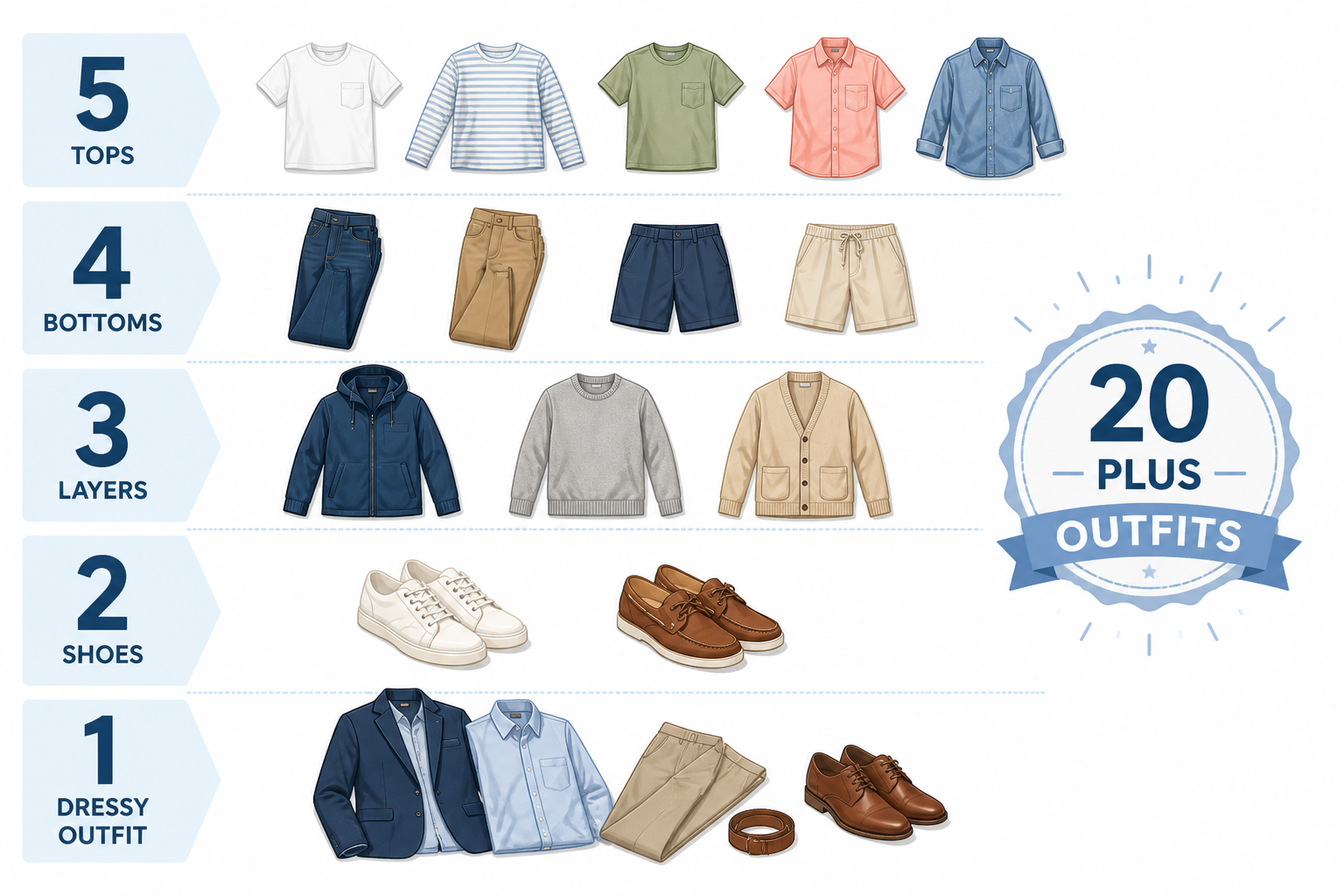
This is the framework that makes carry-on-only travel actually work. Forget vague advice like "pack light." This is a specific system:
Five tops times four bottoms = 20 base outfit combinations. Layer in the three outerwear options and your dressy piece, and you're looking at 40+ distinct looks from just 15 items.
The secret sauce is the capsule wardrobe approach. Pick 2-3 neutral base colors (black, navy, gray, khaki) and add 1-2 accent colors that pop. Every top should work with every bottom. No orphan pieces.
A quick test before packing: lay out everything on your bed and make sure each item pairs with at least three others. If something only works with one outfit, leave it behind.
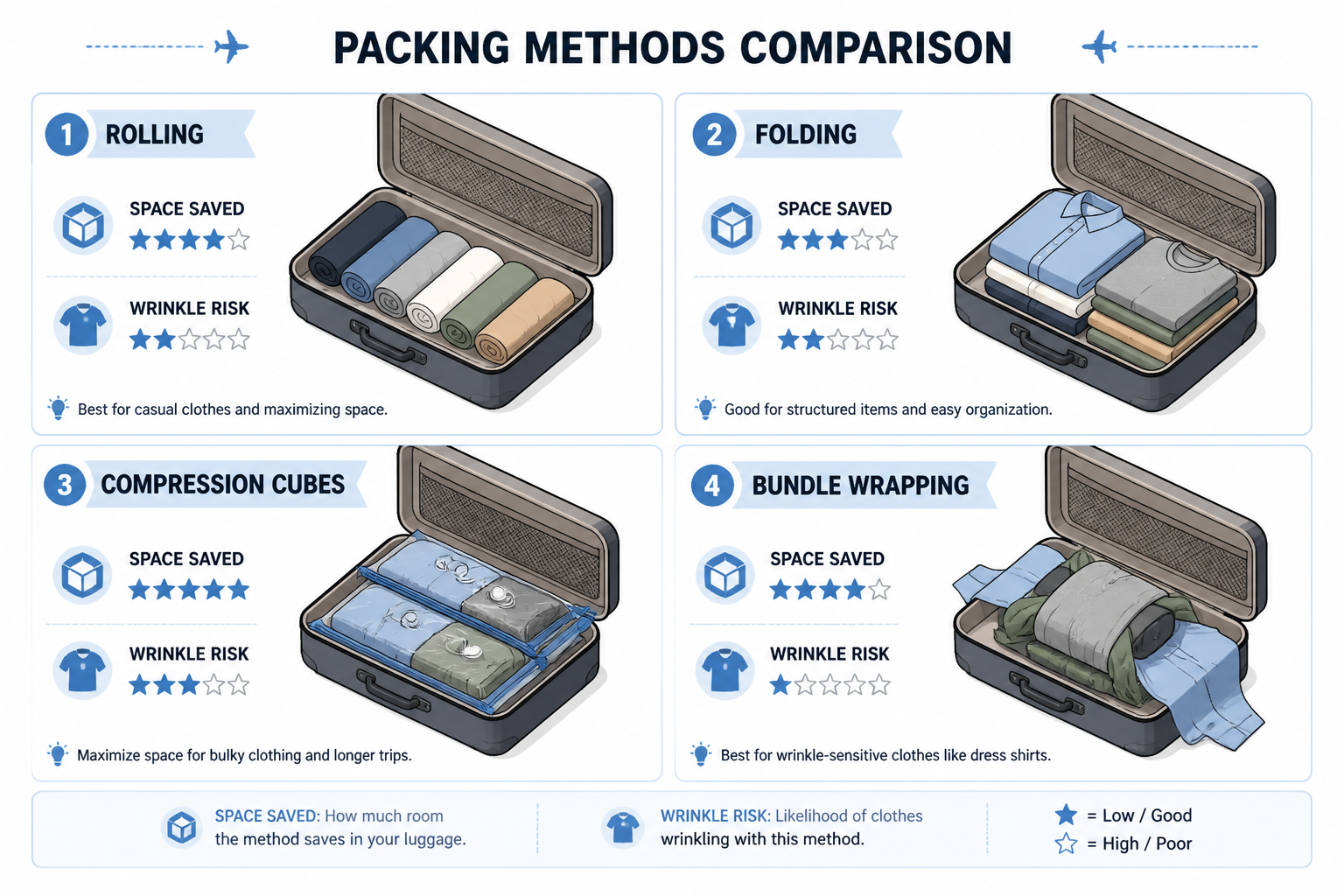
Everyone has opinions about the "right" way to pack. Here's what actually matters based on real-world testing:
| Method | Space Saved | Wrinkle Risk | Organization | Best For |
|---|---|---|---|---|
| Rolling | 15-20% vs flat fold | Low | Good — easy to see items | T-shirts, casual clothes, underwear |
| Flat Folding | Baseline | High | Fair — stacking hides items | Dress shirts, blazers, slacks |
| Compression Cubes | 20-40% for bulky items | Medium | Excellent — modular system | Sweaters, jackets, bulky layers |
| Bundle Wrapping | 10-15% | Very Low | Poor — must unwrap everything | Business trips with wrinkle-prone fabrics |
The winning combo: Roll casual items, use compression cubes for bulky layers, and flat-fold anything structured. This hybrid approach maximizes space while keeping wrinkles under control.
Absolutely — but with a caveat. Standard packing cubes organize space; they don't compress it. For real compression, go with double-zip compression cubes that squeeze out excess air.
The real value is organization. Color-code your cubes (tops in one, bottoms in another) and you can find anything in seconds without demolishing your entire bag.
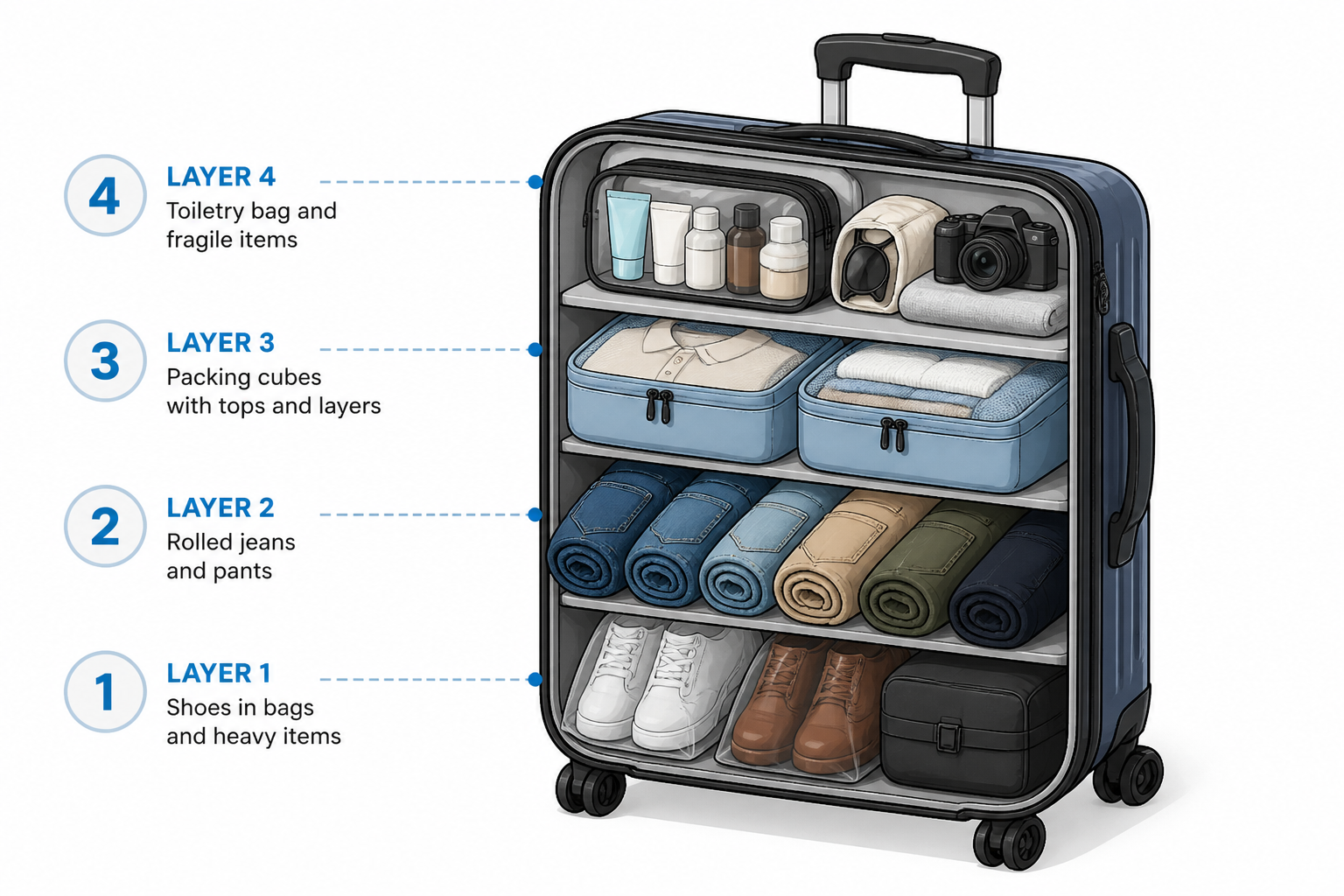
How you load your bag matters almost as much as what you put in it. Here's the optimal order from bottom to top:
Layer 1 — Bottom (wheels side): Shoes in bags or shower caps along the bottom edges. Heavier items like jeans go here too — keeps the center of gravity low so the bag rolls smoothly.
Layer 2 — Middle: Packing cubes with rolled clothing. Fill gaps between cubes with socks, underwear, and small items.
Layer 3 — Top: Wrinkle-prone items laid flat. Dressy outfit, button-downs, anything you don't want crushed. A dry cleaning bag between layers reduces friction and wrinkles.
Layer 4 — Lid pocket: Anything you need during the flight or right after landing. Charger, headphones, travel documents.
Pro tip: Wear your heaviest and bulkiest outfit on the plane. That means your jacket, boots, and your thickest pants. It looks a little ridiculous in July, but it frees up massive space in your bag.
Toiletries are where most people blow their packing budget. The TSA 3-1-1 rule hasn't changed in 2026: liquids must be in 3.4-ounce (100ml) containers, all fitting in one quart-sized clear bag, one bag per person.
But here's the move that changed my packing game: go solid wherever possible.
For everything else, most hotels provide shampoo, conditioner, and body wash. Unless you're in hostels or vacation rentals, skip the bottles and save the space. A well-packed toiletry kit for a week should fit in one small pouch.
Here's the real unlock for packing a carry-on for 7 days or more: plan to do one load of laundry mid-trip.
This doesn't mean hunting for a laundromat (though that's fine too). It means sink washing — the simplest travel skill nobody teaches you.
Pack a few laundry sheets or detergent packets. They're flat, weigh nothing, and don't count as liquids for TSA. Toss in a universal sink plug (under $5, fits any drain).
The method takes 10 minutes:
Do this on day 3 or 4 and you effectively double your wardrobe. Suddenly 5 tops covers two weeks, not just one.
Quick-dry fabrics like merino wool and synthetic blends dry fastest. Cotton takes longer — plan accordingly.
Electronics multiply if you let them. Here's a tight tech kit for a week:
Skip the laptop if you can. If you can't, pack it in your personal item — it doesn't eat into your carry-on clothing space that way.
One important rule: power banks must go in your carry-on or personal item, never in checked luggage. If your carry-on gets gate-checked, pull the power bank out and carry it on board.
The hardest part of packing a carry-on for a week isn't knowing what to bring. It's admitting what you don't need.
Here's what experienced carry-on-only travelers consistently leave behind:
The golden rule: if you're debating whether to bring something, you don't need it.
While you're trimming your packing list, let Autopilot handle your flight booking. We monitor your booking after purchase — so while you're perfecting your capsule wardrobe, we're watching for price drops and schedule changes.
Here's your at-a-glance list for a 7-day carry-on trip:
Clothing (in packing cubes):
Toiletries:
Tech (in personal item):
Yes. Using the 5-4-3-2-1 formula and packing cubes, 7 days of clothing, toiletries, and tech fit comfortably in a standard 22x14x9-inch carry-on. The key is choosing versatile, mix-and-match pieces and planning one mid-trip laundry session for longer trips.
A bag measuring 22 x 14 x 9 inches (56 x 36 x 23 cm) including wheels and handles meets the requirements of every major US airline. For European budget carriers like Ryanair and EasyJet, the free allowance is smaller — around 40 x 30 x 20 cm — so you may need to pay for overhead bin access or use a smaller bag.
Standard packing cubes organize space but don't compress it. Compression packing cubes with double-zip designs can reduce volume by 20-40% for bulky items like sweaters and fleeces. Either way, the organizational benefits alone make them worth packing.
Rolling saves 15-20% more space than flat folding and reduces wrinkles for casual clothing. The best approach is a hybrid: roll casual items like t-shirts and underwear, flat-fold structured pieces like dress shirts, and use compression cubes for bulky layers.
Yes — in fact, you must. The FAA requires all lithium battery power banks to be carried in carry-on luggage, never checked. Banks under 100 watt-hours (Wh) are allowed without airline approval. Between 100-160Wh requires approval. Over 160Wh is banned entirely. Most consumer power banks (under 27,000mAh) fall under the 100Wh limit.
The 3-1-1 rule remains unchanged in 2026: each liquid container must be 3.4 ounces (100ml) or less, all containers must fit in one quart-sized clear plastic bag, and each passenger gets one bag. Solid alternatives like shampoo bars, toothpaste tablets, and deodorant sticks don't count toward this limit.
Pack a few laundry detergent sheets (flat, lightweight, TSA-friendly) and a universal sink plug. Fill the hotel sink with warm water, add a sheet, soak your clothes for 15-20 minutes, rinse, roll in a towel to extract water, and hang dry. Most items dry overnight. Do this mid-trip to effectively double your wardrobe.
Two pairs maximum. Wear your bulkiest pair (sneakers or boots) on the plane and pack one lighter pair (sandals, flats, or dress shoes) in your bag. Shoes are the single biggest space consumer in a carry-on, so keeping to two pairs is non-negotiable for one-bag travel.
Packing a carry-on for a week isn't about deprivation. It's about intention. Every item earns its spot. Nothing rides along "just in case."
Once you nail the system — the 5-4-3-2-1 formula, compression cubes, a mid-trip laundry session — you'll wonder why you ever checked a bag. The freedom of walking off the plane and straight to your ride is worth every outfit you left in the closet.
Ready to book your next trip carry-on style? Search flights on Autopilot — we'll show you exactly what's included with your fare so you can pack with confidence. And after you book, we keep monitoring for price drops and schedule changes automatically.
Disclaimer: Airline baggage policies change frequently. Always verify your airline's current carry-on rules before traveling. Information is current as of 2026.

