

Best Seats on a Plane: Where to Sit in 2026
Where to sit on a plane for legroom, less turbulence, fast deplaning, and better sleep. Seat pitch by airline, exit row pros and cons, and expert seat-picking tips.

Where to sit on a plane for legroom, less turbulence, fast deplaning, and better sleep. Seat pitch by airline, exit row pros and cons, and expert seat-picking tips.
There is no single "best seat on a plane." Anyone who tells you otherwise is selling something.
The best seat depends entirely on what you care about most. Legroom? Turbulence avoidance? Getting off the plane first? Sleeping undisturbed for six hours?
I've spent years obsessing over seat maps, and this guide breaks down exactly where to sit based on your specific priority. No fluff, no generic advice — just the data and experience that actually matter.
Before we get into strategy, let's talk about what you're working with. Not all economy seats are created equal — and the differences between airlines are more dramatic than you'd think.
| Airline | Standard Pitch | Seat Width | Extra-Legroom Option | Extra-Legroom Pitch |
|---|---|---|---|---|
| JetBlue | 32–33" | 17.8" | Even More Space | 37–39" |
| Southwest | 31–32" | 17.8" | Open seating (board early) | N/A |
| Delta | 31–32" | 17.2–18.5" | Comfort+ | 34–35" |
| Alaska | 30–32" | 17.5" | Premium Class | 34–36" |
| United | 30–31" | 17.3" | Economy Plus | 34–38" |
| American | 30–31" | 16.2–17" | Main Cabin Extra | 34–38" |
| Spirit | 28" | 17.5" | Big Front Seat | 35–36" |
| Frontier | 28–29" | 17.5" | UpFront Plus | 34" |
The takeaway: JetBlue gives you the most standard legroom without paying a cent extra. Spirit and Frontier give you the least — by a wide margin. And American's narrower seat width is noticeable on longer flights.
If you're booking domestic and seat comfort is a priority, airline choice matters as much as seat selection. A middle seat on JetBlue can be more comfortable than an aisle on Spirit. That's not an exaggeration.
Exit rows are the gold standard for legroom in economy. You'll typically get 34–38 inches of pitch versus the standard 30–31. Some exit rows on widebodies offer enough space to fully extend your legs.
But there's a catch. Exit row seats often don't recline, the armrests are fixed (and sometimes house the tray table), and you can't store anything at your feet during takeoff and landing. On some aircraft, the window at exit rows is misaligned or absent entirely.
If you want legroom without exit-row trade-offs, bulkhead seats give you open floor space in front of you. No seat-back encroaching into your space. The downside: no under-seat storage, tray tables fold out of the armrest (making the seat slightly narrower), and you're often seated near families with bassinets.
The budget play: Airlines like United (Economy Plus) and JetBlue (Even More Space) dedicate entire sections to extra-legroom seats. These cost $40–$150 extra per segment but give you 34–39 inches with none of the exit-row restrictions.
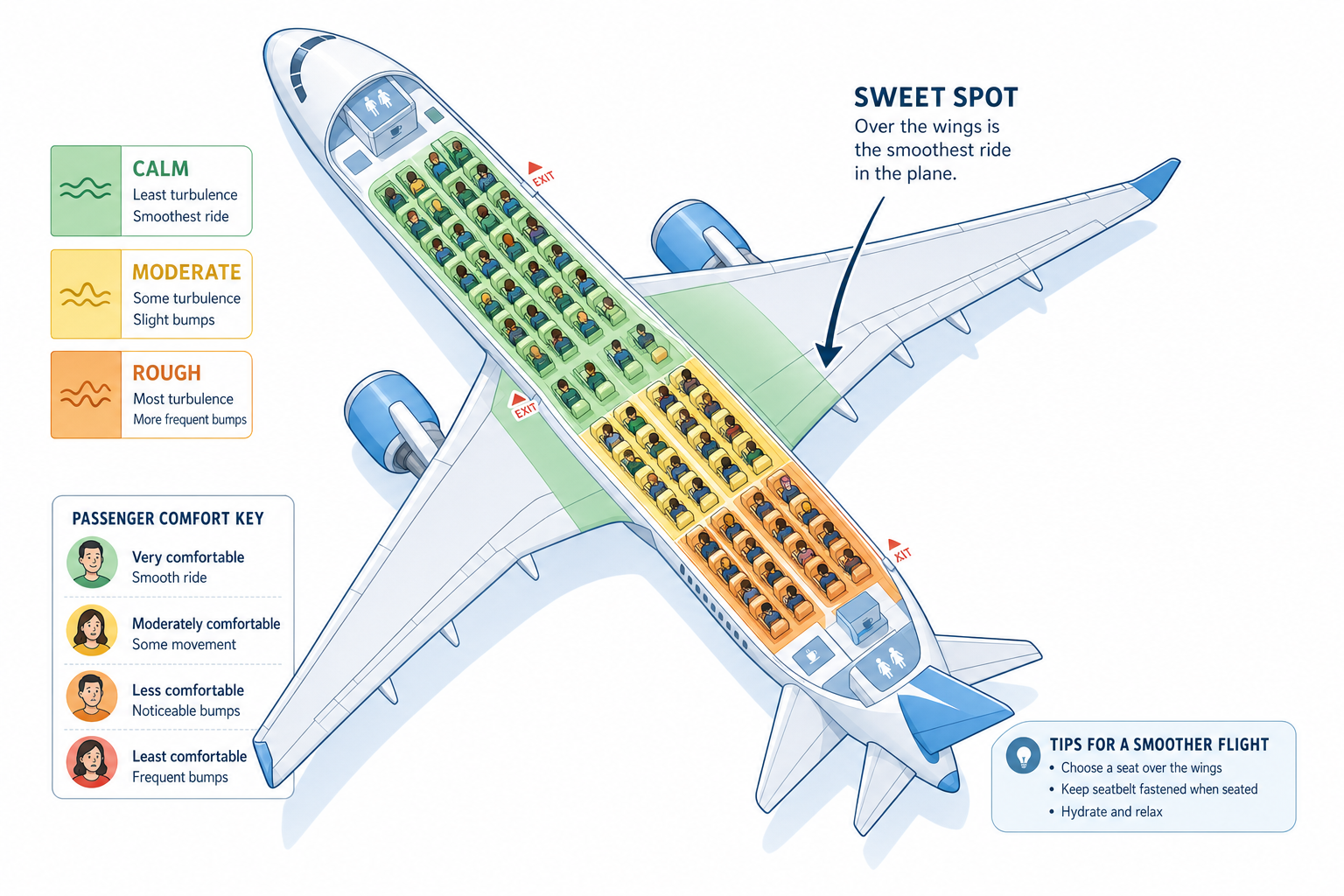
Physics makes this one simple. The smoothest ride is directly over the wings, at or near the aircraft's center of gravity.
Think of the plane like a seesaw. The center of gravity is the fulcrum. Passengers seated there barely move. Passengers at the extremes — front and especially back — get the full seesaw effect.
During moderate turbulence, a passenger in the last row of a Boeing 737 can experience two to three times the vertical acceleration compared to someone over the wing. That's a measurable, physics-based difference — not a placebo.
For anxious flyers or anyone prone to motion sickness, rows 14–20 on a 737 or rows 25–35 on a widebody (depending on configuration) are your sweet spot. If those are taken, seats forward of the wing are your second-best option.
This one is straightforward: aisle seat, as far forward as possible.
An aisle seat lets you stand immediately when the seatbelt sign turns off. A forward position means fewer rows between you and the door. Combine both and you're off the plane in under two minutes on most narrowbodies.
Row 1–5 in economy, aisle side. That's it. If your airline charges extra for those rows (most do now), it's worth it when you have a tight connection. Missing a connection costs way more than the $25–$50 seat upgrade.
Pro tip: If you're using Autopilot to monitor your flights, the savings from automatic rebooking when prices drop can more than cover the cost of selecting a premium seat up front.
Window seat. Front half of economy. Away from galleys and lavatories. Full stop.
The window gives you a wall to lean against — the single most underrated factor for sleep in economy. No one climbs over you for bathroom breaks. You control the shade. And you get a small pocket of relative quiet compared to the aisle.
The ideal sleep seat is a window in rows 5–15 of economy on a narrowbody, or rows 20–35 on a widebody. You want to be forward enough to avoid engine noise (which is loudest behind the wing) and far enough from galleys that crew chatter and service carts don't wake you.
Over-wing windows are also excellent for sleep — the turbulence reduction means fewer jolts waking you up during cruise. The trade-off is a potentially obstructed view, but if you're sleeping, that doesn't matter.
Not all window seats are real window seats. Exit rows often have misaligned or missing windows. Some bulkhead rows have the window positioned behind your shoulder. And the last row on many aircraft has no window at all.
For the best views, avoid exit rows and the last two rows of any cabin. Rows just forward or aft of the wing give you unobstructed sightlines — you'll see the wing, which is photogenic, plus clear views of the ground below.
On widebodies, seats in the rear third often give the best sunrise and sunset views on east-west routes, depending on your direction of travel. Use the flight path to plan which side of the aircraft faces the view you want.
Bulkhead rows are the most family-friendly seats on any aircraft. Extra floor space for fidgety kids, bassinet attachments for infants on international flights, and easy access to the aisle without climbing over strangers.
On narrow-body 3-3 configurations with two kids: put three family members on one side (parent plus two children), with the other parent in the aisle seat directly across. Everyone's together without needing four consecutive seats.
If your kids might have a meltdown — and let's be honest — sit toward the back. Engine noise naturally masks crying, and you're surrounded by fewer passengers who'll notice. Plus, you're closer to the lavatories for emergency potty runs.
One hard rule: no one under 15 can sit in an exit row. Plan accordingly.
The front of economy, forward of the wing, is the quietest zone. Engine noise projects rearward, so you're escaping the bulk of it. You're also far from the rear galley and lavatories, which are the two loudest non-engine sources on any flight.
The absolute worst for noise: last three rows, especially aisle seats near the rear lavatory. You get engine noise, galley commotion, lavatory traffic, and the queue of passengers standing in the aisle waiting for the bathroom.
If you're sensitive to noise, rows 1–8 in economy on a narrowbody are your best bet. Bring noise-canceling headphones regardless — no seat is truly quiet at 35,000 feet.
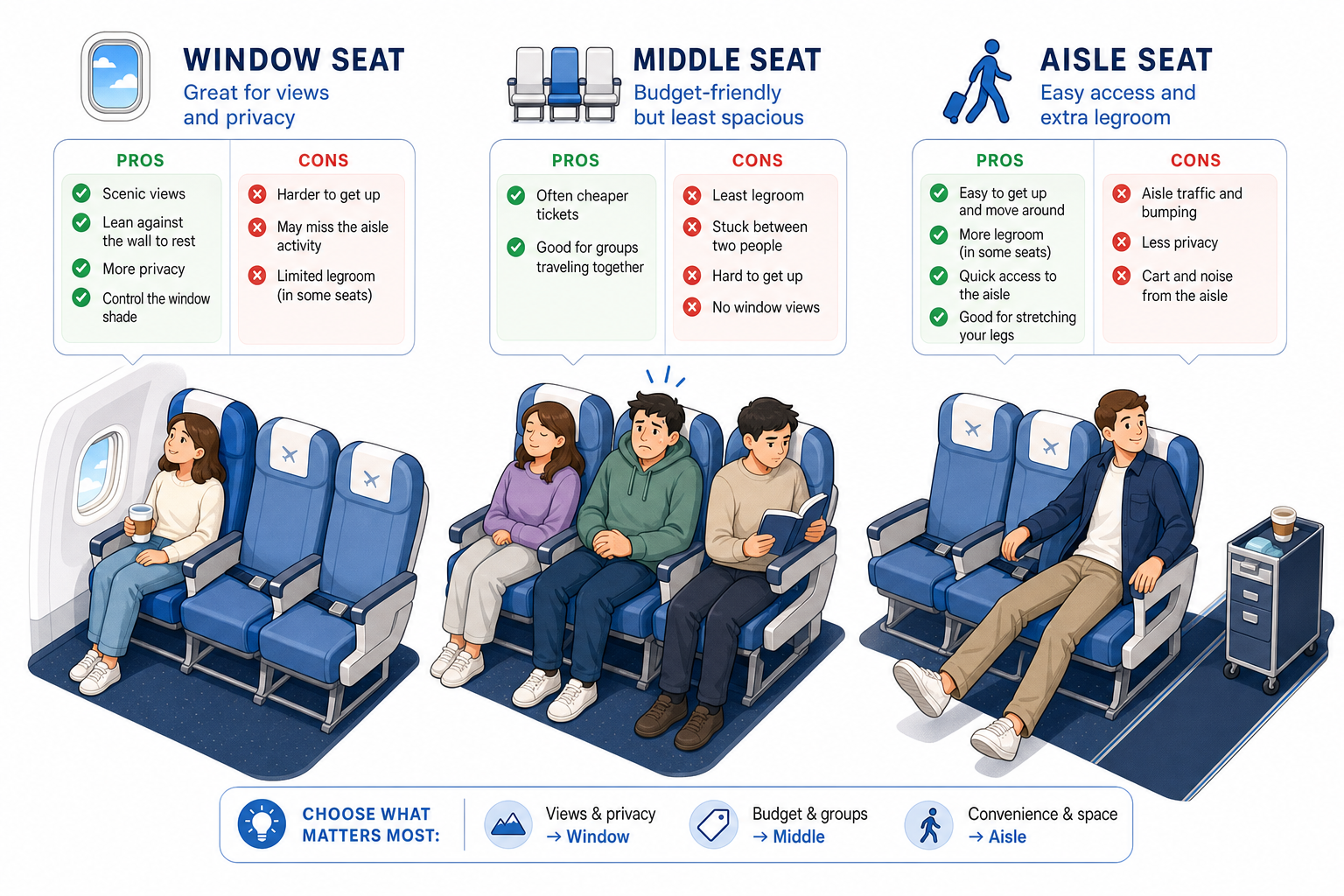
| Factor | Window | Middle | Aisle |
|---|---|---|---|
| Legroom feel | Good (lean into wall) | Worst (boxed in) | Good (extend into aisle) |
| Sleep quality | Best (wall to lean on) | Worst | Poor (bumped by carts/passengers) |
| Bathroom access | Worst (climb over 1–2 people) | Bad (climb over 1 person) | Best (direct access) |
| Deplaning speed | Slowest | Middle | Fastest |
| Privacy | Best | Worst | Moderate |
| Overhead bin access | Hardest | Moderate | Easiest |
| Turbulence bumps | Same as row | Same as row | Same as row (plus cart risk) |
| Views | Yes | No | No |
The verdict: Window for sleeping or scenic flights. Aisle for long legs, frequent bathroom use, or tight connections. Middle only if you're stuck — but at least you get both armrests (that's the unwritten rule, and I'm sticking to it).
Pros: Significantly more legroom (often 36–38"), ability to stretch legs fully, no one reclines into your space from the row ahead.
Cons: Seats often don't recline, armrests are fixed, tray tables are in the armrest (narrower effective width), no under-seat storage during takeoff/landing, windows may be misaligned, can be colder (especially window seats near the door), must be 15+ and physically able to assist in emergency.
Best for: Tall travelers who prioritize leg space over everything else.
Pros: No one reclines into you, extra floor space, bassinet mounting for infants, first off during deplaning (if first-row bulkhead), slightly more personal space feeling.
Cons: All bags must go overhead during takeoff/landing, tray table in armrest (narrower seat), screen fixed in armrest (if no seatback screens), limited legroom due to wall position, often near families with infants.
Best for: Families with babies, passengers who hate being reclined into.
Pros: Sometimes the last seats available, occasionally empty middle seats if the flight isn't full.
Cons: Doesn't recline, maximum turbulence, right next to lavatories (noise, odors, traffic), last to deplane, sometimes no window, galley noise. This is objectively the worst seat on most aircraft.
Best for: No one, honestly. Avoid if you can.
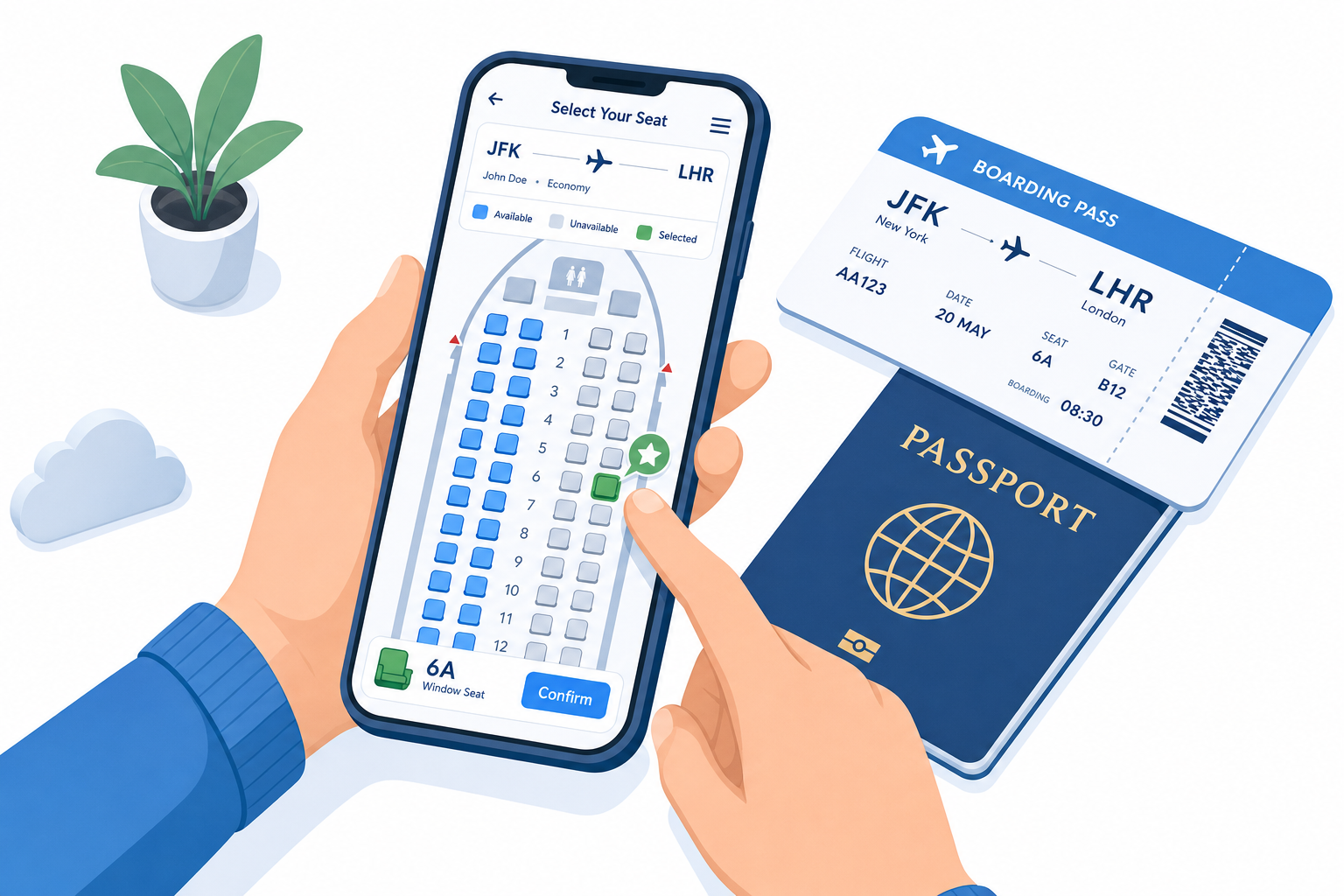
Choosing the right seat doesn't require guesswork. Here's the process I use every single time.
Step 1: Check the aircraft type. Your confirmation email or airline app will show you which plane you're on. A 737-800 is completely different from a 737 MAX 9 in terms of seat layout.
Step 2: Pull up the seat map. Every airline shows seat maps during booking and after. Look for the extra-legroom sections, exit rows, and proximity to lavatories. Green usually means available; yellow or blue means extra cost.
Step 3: Cross-reference with crowd-sourced data. Sites like SeatGuru show you which specific seats have limited recline, misaligned windows, or are narrower than standard. Two minutes of research saves you six hours of regret.
Step 4: Consider paying for an upgrade. If the free seats available are all middle seats in the back, spending $30–$50 on an extra-legroom seat is almost always worth it on flights over two hours. The math works: that's less than a mediocre airport meal, and it dramatically improves your experience.
And if you've already booked? Autopilot tracks your booked flights and automatically rebooks when prices drop. Those savings can fund a seat upgrade you didn't think was in the budget.
Some seats are objectively bad. Here's what to steer clear of:
The pattern is clear: avoid the back, avoid proximity to lavatories and galleys, and never accept a seat without checking the map first.
The difference between a great flight and a miserable one often comes down to a single seat selection. Now you know exactly where to sit for your specific priorities.
Before your next flight, take two minutes to check the seat map. Know your aircraft. Pick based on what matters to you — not what's randomly assigned.
And if you want to make sure you're never overpaying for your flights, Autopilot monitors your booked flights 24/7 and automatically rebooks when prices drop. The average savings? Enough to upgrade from that dreaded last row to a proper extra-legroom seat.
Seat configurations vary by aircraft type and route. Always verify with your airline before selecting seats.
The best seat for minimizing turbulence is directly over the wings, near the aircraft's center of gravity. Passengers over the wing experience significantly less vertical movement — those in the last row can feel two to three times more motion during turbulence compared to over-wing seats.
It depends on your priority. Window seats are better for sleeping (you can lean against the wall) and views. Aisle seats are better for legroom, bathroom access, deplaning speed, and overhead bin access. Neither is objectively better — it's about what matters most to you.
Exit rows offer the most legroom in economy class, typically 34–38 inches versus the standard 30–31 inches. Bulkhead seats also provide extra space. Alternatively, airlines offer extra-legroom sections like JetBlue Even More Space (37–39"), United Economy Plus (34–38"), and Delta Comfort+ (34–35").
Exit row seats are worth it if legroom is your top priority and you don't mind the trade-offs: limited or no recline, fixed armrests with built-in tray tables (narrower effective width), no under-seat storage during takeoff and landing, and potentially colder temperatures near the door. They're ideal for tall travelers on shorter flights.
The worst seats are in the last row of any cabin. They typically don't recline, experience the most turbulence, sit right next to lavatories (noise, odors, foot traffic), and deplane last. Seats directly adjacent to galleys and lavatory queues are also consistently poor choices.
Bulkhead rows offer the most space for families with small children, including bassinet attachments for infants on long-haul flights. For toddlers, choose aisle seats near lavatories for quick bathroom access. If meltdowns are likely, the rear section works well — engine noise masks crying. Note: children under 15 cannot sit in exit rows.
Among major U.S. airlines, JetBlue offers the most standard economy legroom at 32–33 inches of seat pitch without paying extra. Southwest follows at 31–32 inches. For extra-legroom sections, JetBlue's Even More Space leads at 37–39 inches, followed by United Economy Plus at 34–38 inches.
First, identify your aircraft type from your booking confirmation. Then check the airline's seat map for extra-legroom sections, exit rows, and lavatory locations. Cross-reference with SeatGuru for crowd-sourced reviews of specific seats. Prioritize based on what matters most: legroom, quiet, turbulence, sleep, or deplaning speed. And use Autopilot to monitor your fare after booking — if the price drops, automatic rebooking saves you money you can put toward a better seat.

