Is It Rude to Recline Your Airplane Seat? A Frequent Flyer's Honest Take
Few topics in air travel spark more heated debate than airplane seat reclining. It's the flying equivalent of pineapple on pizza — except the stakes involve your kneecaps and someone else's personal space at 35,000 feet.
So is it rude to recline your airplane seat? The short answer: no, it's not rude. You paid for that seat, and recline is a built-in feature. But — and this is a big but — there's an etiquette to it that separates civilized travelers from the person who slams their seat back during meal service.
Let's break down the data, the drama, and the unwritten rules of airplane seat recline etiquette.
What the Data Actually Says About Airplane Seat Reclining
Here's where it gets interesting. According to a comprehensive survey by The Vacationer, more than 77% of flyers think it's rude to fully recline your airplane seat. That's a staggering majority.
But dig into the numbers, and the picture gets more nuanced.
| Opinion |
Percentage of Respondents |
| Think it's rude — and never recline |
45.99% |
| Think it's rude — but ask permission first |
27.87% |
| Think it's rude — but recline anyway without warning |
3.46% |
| Don't think it's rude at all |
22.68% |
So nearly half of all flyers have essentially decided to never recline. Meanwhile, about 28% do recline but have the courtesy to check with the person behind them first. Only about 23% of people think it's a total non-issue.
Here's the kicker, though: the classic FiveThirtyEight survey found that only 41% considered reclining "very or somewhat rude" — which is dramatically lower. The difference? That survey asked about reclining in general, not fully reclining. The distinction matters.
And despite all the hand-wringing, 70% of respondents said they would not want to eliminate the option to recline entirely. People want the choice — they just want everyone to be reasonable about it.
Find Cheaper Flights with Autopilot →
How Far Do Airplane Seats Actually Recline in Economy?
Here's a reality check that might surprise you: the average economy seat reclines just 2 to 4 inches. That's it. We're not talking about a La-Z-Boy situation here.
And that number is shrinking fast. Delta has retrofitted its entire Airbus A320 fleet so economy seats recline only 2 inches — down from the previous 4. American Airlines limited recline on its Boeing 737 MAX economy seats to roughly 2 inches as well.

Premium economy and business class are a different story. Premium economy seats typically offer 6 to 8 inches of recline, while business class lie-flat seats can recline up to 180 degrees. But in the back of the plane, you're fighting over inches — literally.
The trend is clear: airlines are quietly reducing how far your seat can go back. And some are eliminating recline entirely.
Airlines Removing Reclining Seats: Who's Done What
The move away from reclining economy seats has been building for years. Here's where the major airlines stand right now.
| Airline |
Economy Recline Policy |
Recline Distance |
Notes |
| Delta |
Reduced recline |
~2 inches (A320 fleet) |
Retrofitted all 62 A320s in 2024-2025 |
| American Airlines |
Reduced recline |
~2 inches (737 MAX) |
New deliveries have limited recline |
| United |
Standard recline |
~3-4 inches |
Still offers traditional recline |
| Spirit |
Pre-reclined / fixed |
0 inches (no movement) |
Non-reclining since 2009 |
| Frontier |
Pre-reclined / fixed |
0 inches (no movement) |
Fixed seats across fleet |
| Allegiant |
Pre-reclined / fixed |
0 inches (no movement) |
First US carrier to go non-reclining (2006) |
| WestJet |
Standard recline (restored) |
~3 inches |
Tried non-reclining in Oct 2025, reversed Jan 2026 |
| Southwest |
Standard recline |
~3 inches |
Traditional recline maintained |
Budget carriers led the charge. Allegiant was the first US airline to ditch reclining seats back in 2006, with Spirit following in 2009 and Frontier close behind. Their reasoning was practical: non-reclining seats are lighter, cheaper to maintain, and less likely to break.
The weight savings alone can reduce fuel consumption by up to 5% per flight. That's a massive operating cost reduction — and it's why even legacy carriers are quietly trimming recline distances.
The WestJet Experiment That Backfired Spectacularly
WestJet tried to push the non-reclining trend into the mainstream in late October 2025, when it began reconfiguring 43 Boeing 737s with "densified seating." The plan was straightforward: add an extra row of seats, reduce pitch to 28 inches, and make economy seats non-reclining.
It lasted about three months.
Viral videos flooded social media showing passengers with their knees pressed against the seat in front of them. The backlash was swift and brutal — from passengers, media, and even WestJet's own employees.
By January 2026, WestJet announced it would reverse the "densified seating" and convert all 180-seat aircraft back to 174-seat layouts. The airline said it may revisit the concept after further review, but for now, recline is back on WestJet.
The lesson? Passengers hate losing recline more than they hate being reclined on. Go figure.
Save Money on Every Flight — Try Autopilot Free →
The Qatar Airways Incident That Broke the Internet
In January 2026, a Qatar Airways flight from Doha to Moscow became the latest battleground in the seat recline wars — and this one was truly bizarre.
A passenger in seat 24C was unhappy that the person in front of her (23C) reclined their seat. Her response? She propped her feet up on the headrest of seat 23C, essentially using the other passenger's headrest as a footrest. When fellow passengers started filming, her only response was to clap her shoes together.
A flight attendant eventually knelt beside the retaliating passenger and asked her to stop. She refused and continued the behavior for 10 to 15 minutes before finally relenting.
The video went viral, reigniting the global debate about whether reclining is a right, a privilege, or a declaration of war. For the record: reclining is fine. Putting yourfeet on someone's headrest is absolutely not.
The Knee Defender Controversy
No discussion of airplane seat recline etiquette would be complete without mentioning the Knee Defender — a $22 device that clips onto your tray table supports and physically blocks the seat in front from reclining.
It's exactly as controversial as it sounds.
Most major airlines — including Delta, United, American, Air Canada, Qantas, and Virgin — have explicitly banned the Knee Defender. The FAA hasn't formally prohibited the device, but airlines have the authority to ban it under their own policies, and most have.
The most infamous Knee Defender incident happened on a United flight in 2014, when a dispute over the device escalated so badly that the plane was diverted to Chicago O'Hare. Both passengers were removed from the flight.
The bottom line: if you need extra legroom, pay for it. Don't bring gadgets that physically prevent other passengers from using their seat features. That's not etiquette — that's hostage-taking with plastic clips.
Should You Recline Your Seat on a Plane? The Etiquette Rules
Here's my honest take as someone who flies frequently: yes, you should feel free to recline your airplane seat. You purchased a ticket for a seat that reclines, and using that feature is your right.
But rights and etiquette are different things. Here are the unwritten rules that seasoned travelers follow.
1. Check Behind You First
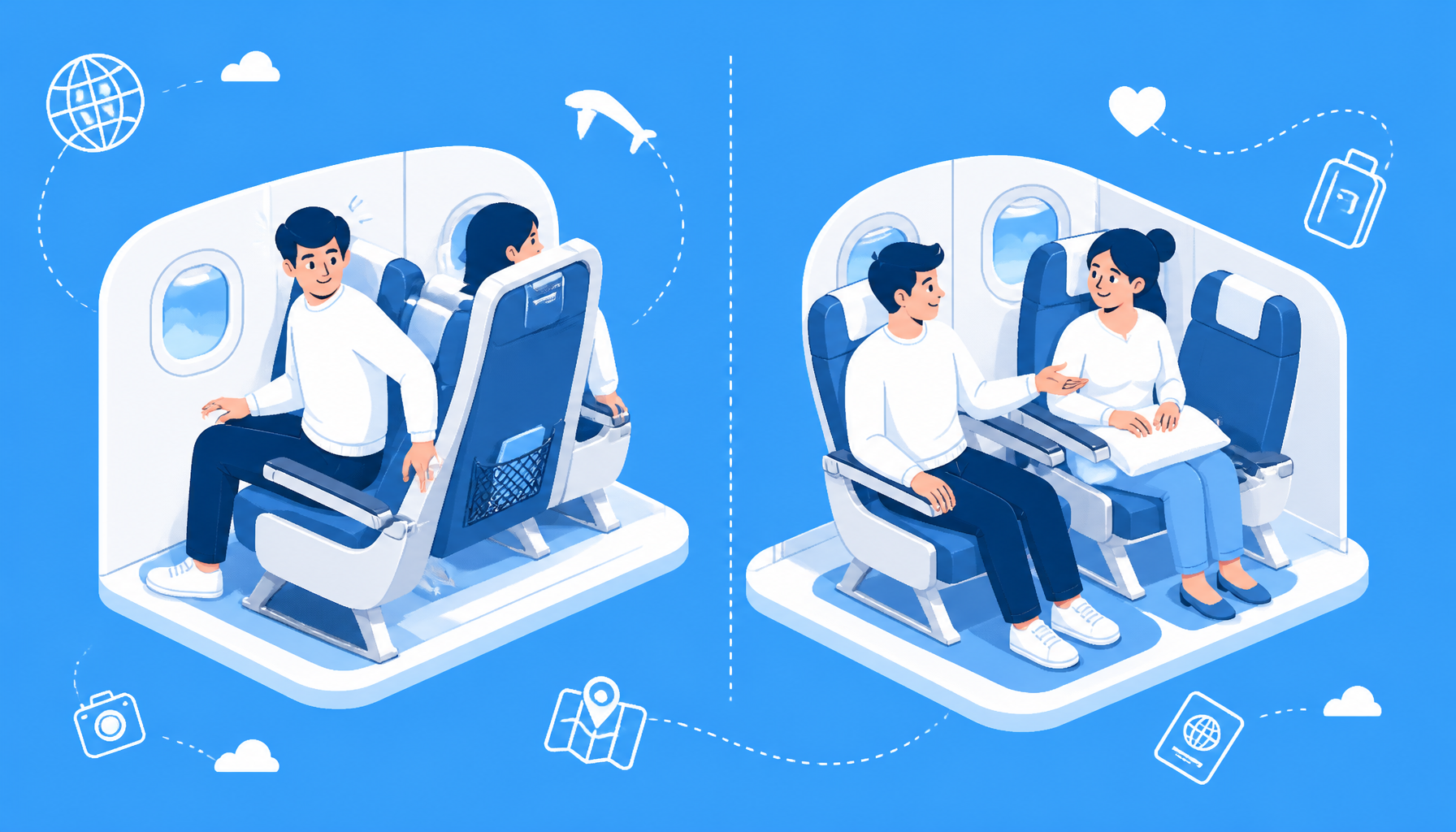
A quick glance over your shoulder costs nothing. If the person behind you is tall, has a laptop open on the tray table, or is eating, hold off for a few minutes. This single gesture prevents 90% of recline-related conflicts.
2. Recline Slowly
The cardinal sin of airplane reclining isn't the recline itself — it's the slam. Ease your seat back gradually. The person behind you deserves a moment to adjust their drink, laptop, or knees before your seat arrives in their personal space.
3. Avoid Reclining During Meal Service
This is probably the most universally agreed-upon rule among frequent flyers. When the person behind you has a tray of food balanced on a surface that's about to get 2 inches closer to their face, just wait. Meal service on domestic flights lasts 20 to 30 minutes. You'll survive.
4. Go Partial on Short Flights
On a 90-minute domestic hop, do you really need full recline? Consider going halfway. You still get some comfort without completely invading the space of the person behind you. Save the full recline for red-eyes and long-hauls.
5. The Exit Row and Bulkhead Exception
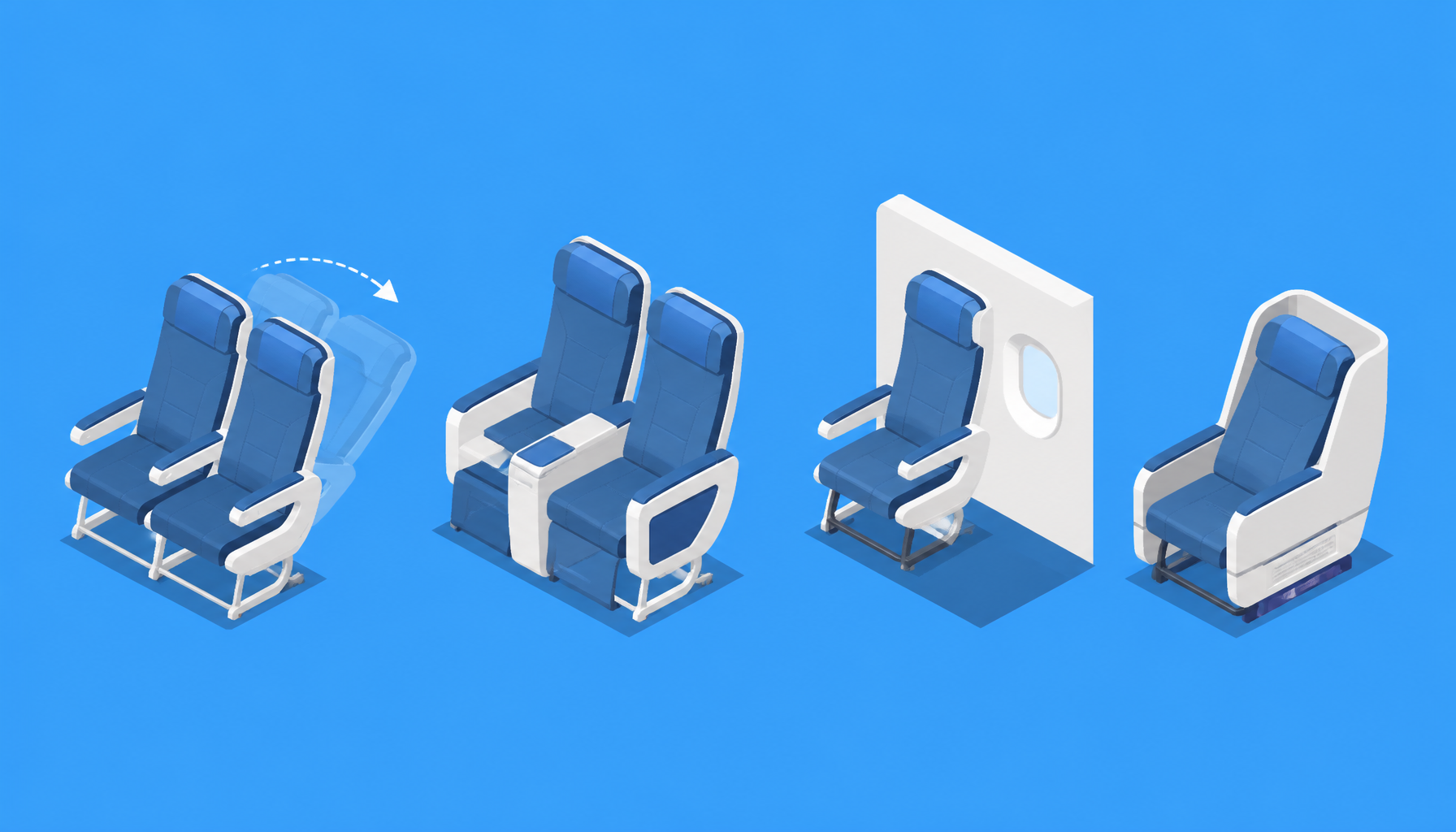
If you're in an exit row or a bulkhead seat, congratulations — nobody can recline into you. These are also the best seats to book if you're tall or if being reclined on drives you nuts. The trade-off is you'll likely have a fixed or reduced-recline seat yourself.
6. Return Your Seat for Landing (and Be Proactive)
Returning your seat to the upright position for landing isn't just etiquette — it's required by the FAA. But good etiquette means putting your seat up a few minutes before the announcement, especially if the person behind you is trying to gather their belongings.
Lock in Your Next Flight with Autopilot →
Best Seats to Book If You Hate Being Reclined On
If recline drama stresses you out, seat selection is your best defense. Here's what to look for when booking.
Exit row seats give you extra legroom and the person in front of you either has a non-reclining seat or severely limited recline. You won't be trapped.
Bulkhead seats (the first row of a cabin section) mean no one is in front of you to recline. The downside: your tray table folds out from the armrest, and you'll stow bags overhead instead of under the seat.
Last row seats are the opposite play. Your seat may not recline at all (or very little), but you also won't have anyone behind you to worry about. They come with downsides — proximity to lavatories, limited recline — but they're worth considering if you want zero conflict.
Premium economy or extra-legroom sections give you enough pitch (34 to 38 inches vs. the standard 28 to 31) that even a full recline from the seat ahead won't feel catastrophic. The extra $30 to $80 is often worth it for peace of mind.
Find the Best Seat at the Best Price →
The Future of Airplane Seat Recline
The industry is clearly trending toward less recline, not more. Airlines are reducing recline distances, budget carriers have eliminated it entirely, and new seat designs increasingly favor fixed or "pre-reclined" configurations that are built at a slight angle but don't actually move.
The financial incentives are powerful. Non-reclining seats are lighter, cheaper to maintain, and reduce the risk of in-flight conflicts that can lead to diversions — which cost airlines anywhere from $10,000 to $80,000 per incident.
But as WestJet learned the hard way, passengers aren't ready to give up recline completely. The sweet spot seems to be what Delta and American are converging on: minimal recline (about 2 inches) that gives the illusion of choice without meaningfully impacting the person behind you.
Within the next few years, don't be surprised if "full recline" in economy becomes a premium upsell rather than a standard feature. Airlines already charge for legroom, checked bags, and seat selection. Charging for recline feels inevitable.
Frequently Asked Questions
Is it rude to recline your airplane seat?
While 77% of flyers consider full recline rude according to survey data, reclining is a built-in feature of your seat that you paid for. The key is etiquette: check behind you first, recline slowly, and avoid reclining during meal service.
How far do airplane seats recline in economy class?
Most economy seats recline 2 to 4 inches, though many airlines are reducing this. Delta's A320 fleet and American Airlines' 737 MAX seats now recline only about 2 inches. Budget carriers like Spirit, Frontier, and Allegiant have fixed seats that don't recline at all.
Which airlines have removed reclining seats in economy?
Spirit, Frontier, and Allegiant all have non-reclining "pre-reclined" seats in economy. WestJet tried removing recline in October 2025 but reversed the decision in January 2026 after passenger backlash. Delta and American have reduced recline to about 2 inches rather than eliminating it.
What is a Knee Defender and is it allowed on flights?
The Knee Defender is a device that clips onto tray table supports to block the seat in front from reclining. Most major airlines including Delta, United, American, Air Canada, Qantas, and Virgin have banned it. Using one can result in removal from a flight.
Should you ask permission before reclining your airplane seat?
It's not required, but it's a widely appreciated courtesy. About 28% of flyers say they ask permission before reclining. At minimum, glance behind you to check if the person has a laptop open or is eating before you recline.
What are the best seats to avoid being reclined on?
Exit row seats and bulkhead seats are your best options — the person in front either can't recline or has severely limited recline. Premium economy sections also offer enough extra legroom that a recline from ahead won't feel as intrusive.
Do airplane seats recline on short flights?
Yes, on most airlines the recline mechanism works regardless of flight length. However, experienced travelers typically avoid full recline on flights under 2 hours as a matter of courtesy. Some regional jets have limited or no recline due to smaller cabin configurations.
Are airlines going to eliminate reclining seats completely?
The trend is toward less recline, not zero recline. Budget carriers already have fixed seats, and legacy airlines like Delta and American are reducing recline to about 2 inches. Full elimination is unlikely on major carriers after WestJet's failed attempt, but recline may eventually become a paid upgrade.
Start Saving on Flights Today →
Disclaimer: Airline policies change frequently. Always verify current seat configurations and policies directly with your airline before travel. Autopilot helps you save on flights automatically — we monitor prices after you book and get you money back when fares drop.


